RV Refrigerator Repair: Complete Diagnostic and Cost Guide
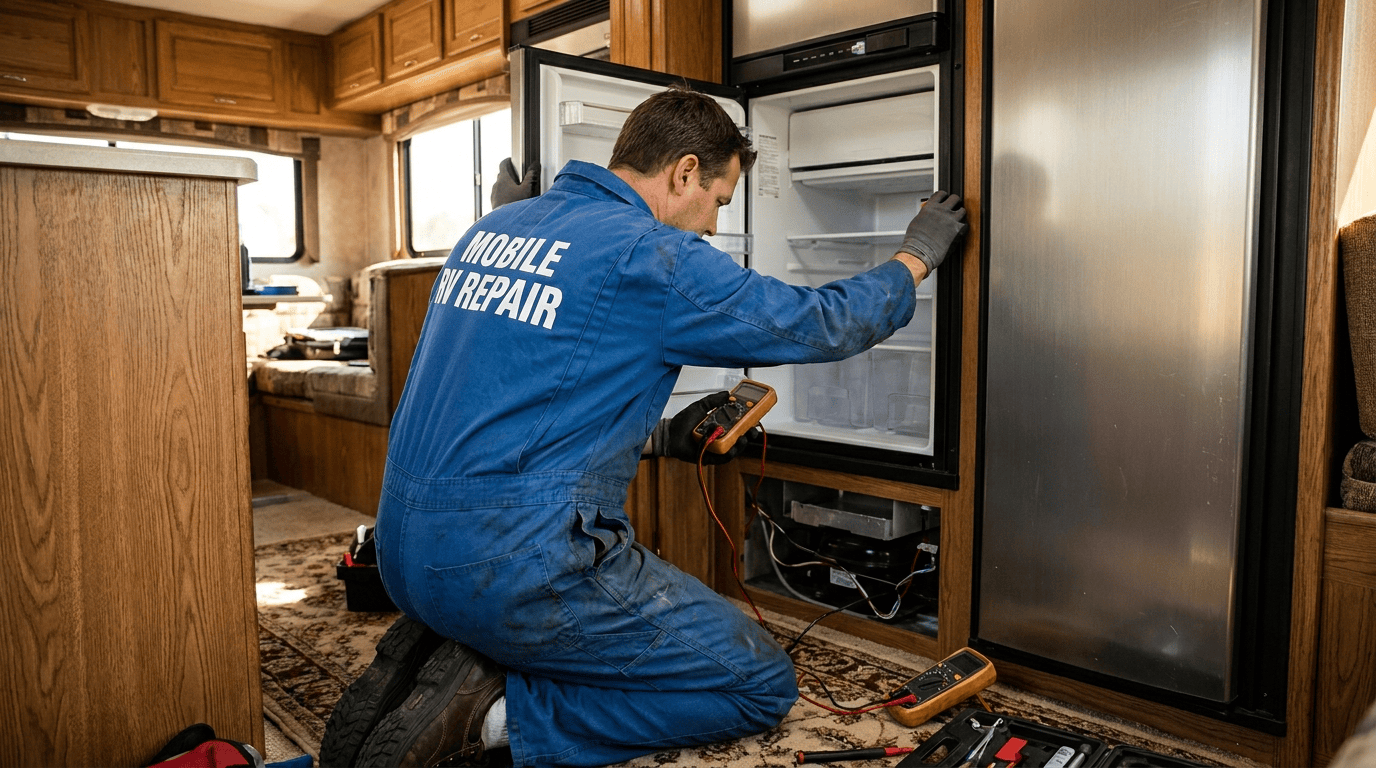
An RV refrigerator that won’t cool is the fastest way to ruin a trip. Groceries spoil in hours. You’ve spent thousands on a rig built for freedom, and you’re standing next to a warm fridge trying to decide whether to drive to the nearest grocery store twice a day or cut the trip short.
Before you panic — or call a tech and hand over a blank check — most RV refrigerator problems fall into a small set of causes you can actually diagnose yourself in about 30 minutes. Some of them you can fix. Others tell you exactly what to tell the tech so they show up with the right part and don’t waste an hour figuring it out on your dime.
This is the diagnostic and cost guide we wish every RV owner had before their first fridge failure.
Understand What Kind of Fridge You Have
Three different refrigerator types are common in RVs, and they fail differently:
Absorption (Norcold, Dometic gas/electric models)
The traditional RV fridge. Runs on propane or 120V AC. No compressor — cooling comes from ammonia solution circulating through coils heated by a flame or electric element. Silent, no moving parts, but slow to cool and sensitive to being unlevel. This is what’s in most rigs older than a few years.
Residential (Whirlpool, Samsung, LG in RVs)
A standard household refrigerator installed in the RV. Runs on 120V AC only, requires inverter and battery bank for off-grid use. Cools much better and faster than absorption. More common in newer Class A and fifth wheels.
12V DC compressor (Norcold Polar, Dometic CRX, Isotherm, etc.)
Newer technology. Compressor-driven like a household fridge but runs directly on 12V. Cools well, works while unlevel, uses more battery. Increasingly common in Class B vans and newer builds.
Which one you have matters because the failure modes and repair costs are completely different.
Symptoms and What They Mean
Match your symptom to the likely cause. This narrows the diagnostic tree from twenty possibilities to two or three.
Fridge not cooling at all (freezer warm, fridge warm)
- Absorption: cooling unit failure, thermistor, control board, or vent obstruction
- Residential: inverter or shore power failure, compressor, or thermostat
- 12V DC: battery/power issue, compressor, or thermostat
Fridge cools but freezer doesn’t (or vice versa)
- Absorption: thermistor placement or failure, air circulation blockage
- Residential: defrost system, air damper, or thermostat sensor
- 12V DC: thermistor or fan failure
Cools intermittently — sometimes works, sometimes doesn’t
- Absorption: gas/electric switching problem, control board, or venting issue (heat can’t escape)
- Residential: loose connection, inverter cycling, or thermostat
- 12V DC: low voltage cutoff triggering, wiring issue
Cools only on propane, not electric (or vice versa)
- Absorption only: heating element (electric side) or gas valve/burner (propane side)
Smells like ammonia or you see yellow residue
- Absorption: cooling unit is dead. This is the expensive one.
Won’t stay lit on propane
- Absorption: thermocouple, gas pressure, orifice, or dirty burner
Ice buildup on the cooling fins
- Any type: door seal failure or defrost cycle issue
The 30-Minute Diagnostic Checklist You Can Do Yourself
Before calling a tech, run through this. Even if you don’t fix the problem, you’ll give the tech a running start.
1. Level check (absorption only). Absorption fridges need to be reasonably level to work. If you’re parked at an angle for more than a couple hours, the cooling unit can be damaged permanently. Level the rig and give it 24 hours.
2. Power check. Confirm the fridge is actually getting power. Test the outlet with a multimeter (residential and 12V) or check the flame if it’s on propane (absorption). If nothing’s coming in, the problem isn’t the fridge.
3. Thermistor position (absorption). Open the fridge, find the thermistor clipped to a fin inside. It should be positioned per the manual — usually middle to upper area. Wrong placement causes the fridge to think it’s cold when it isn’t. This is the single most common absorption fridge issue and it’s a $15 part.
4. Vent check. Look at the exterior vent for your fridge (usually on the sidewall, sometimes on the roof). Bugs, dust, and debris block airflow. Ammonia fridges need heat to escape — blocked vents cause cooling failure. Clear it, run a small fan behind it if you can.
5. Battery voltage (12V DC). These fridges cut out below about 10.5V. If your house battery is dying, the fridge stops. Check voltage under load.
6. Door seal test. Close a dollar bill in the door and try to pull it out. If it slides easily, the seal is bad, warm air is leaking in, and the fridge is fighting a losing battle.
7. Freezer frost check. A little frost is normal. Heavy ice buildup on the fins or back wall points to a defrost or seal problem.
8. Fan check. Most modern RV fridges have an interior fan and sometimes an exterior one on the vent. If they’re not running, cooling drops dramatically. Listen for them.
9. Control board fault codes. Newer absorption units display fault codes on the panel. Photograph the code and Google it (or check your manual) before calling anyone.
10. Age and history. If your fridge is over 12 years old and this is the third failure, you’re near end-of-life on the cooling unit. Time to decide: repair, rebuild, or replace.
What RV Refrigerator Repair Costs in 2026
Cost varies enormously by which failure you’re dealing with. Here are the realistic 2026 ranges:
| Repair | Parts Cost | Labor | Total |
|---|---|---|---|
| Thermistor replacement (absorption) | $10 – $30 | $95 – $200 | $100 – $230 |
| Control board (absorption) | $200 – $500 | $150 – $300 | $350 – $800 |
| Heating element (absorption electric) | $80 – $180 | $150 – $250 | $230 – $430 |
| Gas valve or burner assembly | $100 – $300 | $200 – $400 | $300 – $700 |
| Thermocouple | $25 – $75 | $100 – $200 | $125 – $275 |
| Door seal replacement | $80 – $250 | $50 – $150 | $130 – $400 |
| Cooling unit rebuild (absorption) | $900 – $1,500 | $600 – $1,000 | $1,500 – $2,500 |
| Cooling unit replacement (absorption) | $1,400 – $2,200 | $700 – $1,200 | $2,100 – $3,400 |
| Full absorption fridge replacement | $1,800 – $3,500 | $500 – $900 | $2,300 – $4,400 |
| Residential fridge swap-in | $1,200 – $2,500 | $600 – $1,200 | $1,800 – $3,700 |
| 12V DC compressor replacement | $600 – $1,400 | $400 – $800 | $1,000 – $2,200 |
| Full 12V DC fridge replacement | $2,200 – $4,500 | $500 – $900 | $2,700 – $5,400 |
Ranges reflect national averages. Mobile tech pricing runs slightly higher than shop labor but saves you a tow and days of downtime.
When to Repair vs When to Replace
The decision usually comes down to two things: age and failure type.
Repair when:
- Fridge is under 10 years old
- The failure is a component (thermistor, board, seal, element) — not the cooling unit itself
- Repair cost is under 40% of replacement cost
- You’re satisfied with the fridge’s baseline performance
Replace when:
- Cooling unit is dead (ammonia leak, yellow residue) and the fridge is over 10 years old
- This is the second or third major failure in three years
- Repair estimate is over 50% of replacement cost
- You want an upgrade (going from absorption to residential or 12V)
Consider a residential swap-in when:
- Your rig has an inverter and adequate battery capacity, or you’re mostly plugged in
- You want faster cooling and larger capacity
- You want to end the leveling-related failure risk that absorption fridges have
Recalls and Model-Specific Issues You Should Know
Norcold recalls: Norcold has had multiple recalls related to cooling unit fire risk in the N6, N8, and 1200-series units. If you have a Norcold, look up your model number and serial at the manufacturer site to confirm your unit has been through the recall repair.
Dometic gas absorption: Certain Dometic models have known control board and thermistor failure patterns. Some are covered under class-action settlements; check your model.
Recall history matters when buying a used RV. Any pre-purchase inspection should include a fridge model and serial check against active recalls.
Finding a Mobile Tech Who Handles Refrigerator Repair
Not every mobile tech works on refrigerators. Absorption cooling units in particular require specific training — refrigerant is under pressure, cooling units are heavy and awkward to remove, and misdiagnosing a cooling unit failure means you replace a $2,000 part that didn’t need replacing.
When calling around, ask specifically:
- Do you handle absorption fridges, residential, and 12V DC, or just some?
- Have you done cooling unit swaps or just component work?
- Can you handle a full fridge swap-in (removing old, installing new)?
- Do you have experience with my brand (Norcold, Dometic, Whirlpool, Isotherm)?
Frequently Asked Questions
How long should an RV refrigerator last?
Absorption units typically last 10–15 years before cooling unit failure. Residential fridges last 12–18 years. 12V DC compressor fridges are newer but should last 15+ years with proper care.
Why does my RV fridge work at home but fail on the road?
Almost always leveling or ventilation. Home spots tend to be level with good airflow. Campground sites often aren’t. Your fridge will tell you.
Is it worth replacing an absorption fridge with a residential one?
For most owners who camp with power hookups or have a solid inverter/battery setup, yes. Residential fridges cool better, cost less to replace, and don’t fail catastrophically the way absorption units do. Downsides: they use more power off-grid and are heavier.
Can I run my RV fridge while driving?
Absorption fridges can run on propane while driving in most states (check your local laws, some tunnels and bridges prohibit it). Residential and 12V DC fridges run off inverter and battery while driving.
What causes an RV fridge to smell like ammonia?
The cooling unit has cracked or corroded and ammonia is leaking. The fridge is dead — no repair short of a full cooling unit replacement will fix it.
How much does it cost to replace an RV refrigerator?
Full replacement in 2026 runs $1,800–$4,400 for absorption, $1,800–$3,700 for a residential swap-in, and $2,700–$5,400 for a 12V DC unit. Mobile installation typically saves 15–25% vs a dealership.
In a hurry?
Skip the diagnostic → Find a mobile tech near you