RV Slide-Out Won’t Retract: Complete Diagnostic and Repair Guide
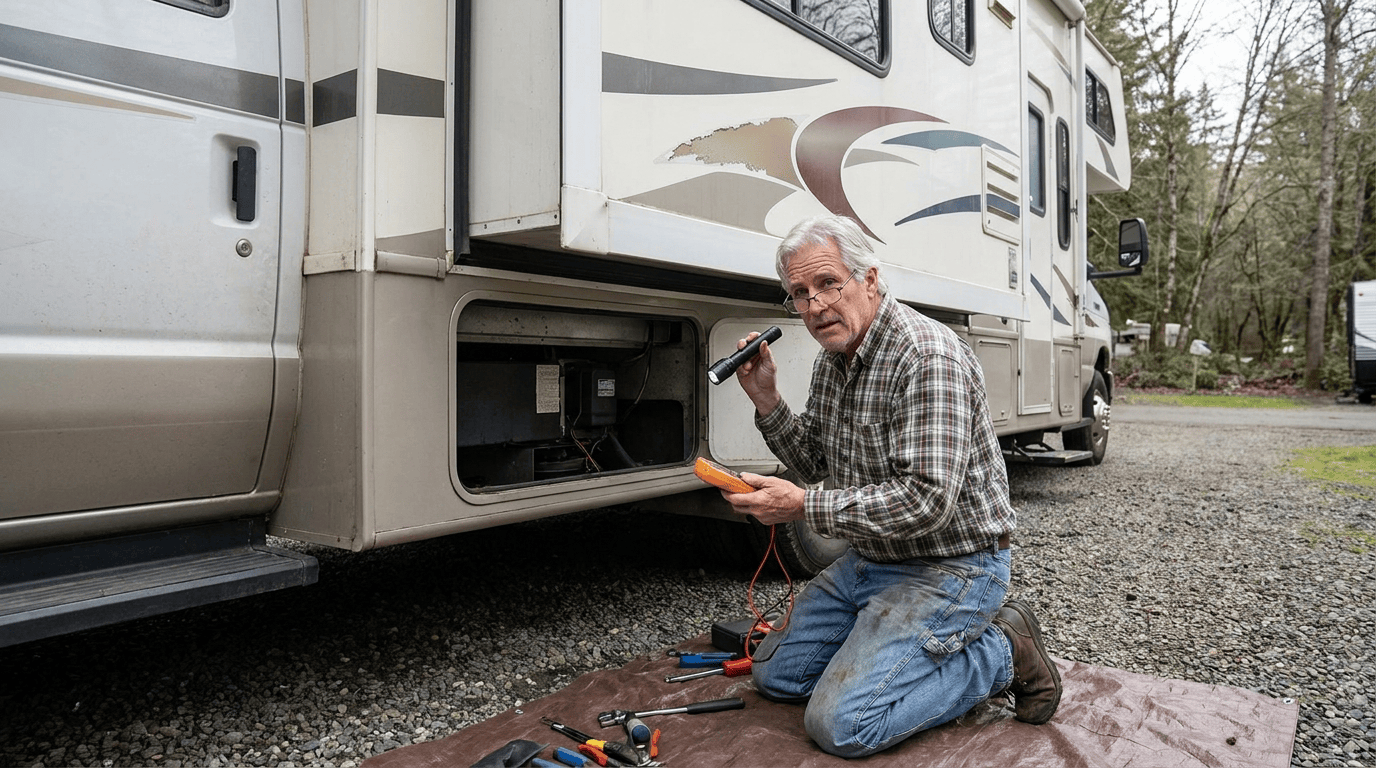
You’re checking out of the campground in the morning. Or worse, you’re already in a Walmart parking lot 400 miles from home, ready to keep driving. You hit the switch and the slide moves an inch — or doesn’t move at all — and now you’re stuck.
A stuck slide-out is one of the most stressful failures in RV ownership. You can’t drive with the slide out. You can’t unlock the doors. You can’t set up camp. And every hour that passes is another hour a mobile tech may not be available.
Before you panic — or authorize a $2,000 repair from the first shop that answers the phone — most slide-out failures fall into a small set of causes you can actually diagnose in about 20 minutes. Some of them you can fix. Others you can at least retract manually to get on the road and deal with properly later.
This is the diagnostic guide we wish every RV owner had before their first slide failure.
First: Know What Kind of Slide You Have
There are four common slide-out mechanisms. Each fails differently, is diagnosed differently, and costs different amounts to repair. Look at your slide before you do anything else.
Electric rack-and-pinion (Lippert, BAL, Power Gear)
The most common in newer travel trailers and fifth wheels. A motor drives gears that push the slide in and out on horizontal rails. Silent-ish when working, distinct grinding when failing.
Hydraulic (HWH, Lippert Level Up, Power Gear hydraulic)
Common in Class A motorhomes, high-end fifth wheels, and any rig with heavy slides. A hydraulic pump pushes fluid through cylinders that move the slide. You’ll hear the pump running when you operate the slide.
Schwintek (Lippert Schwintek in-wall system)
Common in newer travel trailers and lighter slides. Motors are mounted vertically inside the wall channels. No visible mechanism from inside. Distinctive high-pitched motor whine when operating.
Cable-driven (older systems, some Airstream and specialty rigs)
Slide moves via cables driven by a central motor. Less common in modern rigs but still around in older fifth wheels.
Not sure which you have? Look under the slide from outside — if you see horizontal rails and a big motor, it’s rack-and-pinion. See hydraulic cylinders and lines? Hydraulic. Nothing visible and motors up inside the wall channels? Schwintek. Cables and pulleys? Cable-driven.
Your owner’s manual specifies the system by name. If you have a 2015+ fifth wheel or travel trailer, it’s most likely a Lippert product (either rack-and-pinion or Schwintek). If you have a 2010+ Class A, it’s most likely hydraulic.
Symptoms and What They Mean
Match your symptom to the most likely cause. This narrows the diagnostic tree fast.
Slide won’t move at all, no motor sound
- Battery voltage too low (very common — this is the #1 cause of “dead” slides)
- Blown fuse on the slide circuit
- Failed switch
- Failed controller/motor relay
- Motor completely dead (rare unless there’s a history)
Motor runs but slide doesn’t move
- Rack-and-pinion: sheared gear, broken pinion, or motor coupler failure
- Schwintek: stripped gear teeth in the wall channel (common failure mode)
- Cable-driven: broken or slipped cable
- Hydraulic: low hydraulic fluid, air in the lines, or failed pump seal
Slide moves partway then stops
- Rack-and-pinion: obstruction, worn gears binding, or motor overheating
- Schwintek: one motor working, one not (they’re supposed to move in sync)
- Hydraulic: low fluid or one cylinder failing
- Any type: seal binding on the wiper seal from age, debris, or freeze damage
Slide grinds, clicks, or squeals but doesn’t move (or barely moves)
- Gear damage in progress — stop operating it immediately or you’ll destroy more
- Bearing failure
- Metal-on-metal contact from misalignment
- Bent rack (rack-and-pinion)
Slide moves unevenly (one side out further than the other)
- Schwintek: one motor failing (the two motors need to synchronize)
- Rack-and-pinion with dual motors: same problem
- Hydraulic: one cylinder losing pressure
- Alignment issue that needs professional attention
Slide moves fine going out but won’t come back in
- Wall seals binding (very common in cold weather)
- Weight on the slide floor (yes, really — check for water tanks, generator, or gear that shifted)
- Motor overheated and needs to cool down (wait 30 minutes)
- Directional relay failure (motor works one direction only)
Clicking sound only, no motor
- Solenoid clicking without motor engagement — battery voltage is likely too low
- Failed solenoid
- Broken wiring to the motor
Fluid leak visible (hydraulic only)
- Failed hydraulic cylinder seal
- Cracked hydraulic line
- Failed pump seal
- Low fluid causing pump cavitation
The 20-Minute Diagnostic Checklist
Before calling anyone, run through this. Even if you don’t fix it, you’ll give a tech a huge head start.
1. Check battery voltage under load.
This is the single most common cause of slide problems, and it costs nothing to check. Slides pull massive current — 20 to 60 amps depending on the system. If your house battery reads 12.4V at rest but drops to 11.5V or lower when you try to operate the slide, the battery isn’t providing enough juice to run the motors properly.
Solutions: plug into shore power, run the generator, or charge the battery bank. Then try again.
2. Check the fuse on the slide circuit.
Consult your manual for the fuse location. It’s usually in the main 12V distribution panel, labeled “SLIDE” or similar. Slides typically use 30–50 amp fuses. If it’s blown, replace it with the exact same amperage and try again — but if it blows immediately, you have a short somewhere and need professional help.
3. Listen carefully when you activate the switch.
Silence means an electrical problem (power, switch, fuse, or motor).
A click but no motor means a relay/solenoid problem or very low voltage.
A motor sound with no movement means a mechanical failure (gear, cable, coupler).
A grinding sound means stop immediately — you’re destroying something.
4. Look for physical obstructions.
Walk around the slide inside and out. Check for:
- Items on the slide floor holding weight (fridge full of groceries, water bottles, furniture)
- Debris in the seals or tracks (leaves, ice, gravel)
- Awning or slide topper caught somewhere
- Frozen seals (in cold weather, the seals can literally freeze to the wall)
5. Check the switch itself.
If you have another slide on your rig, try that switch. If it works, the failed slide’s switch might just be dead. Sometimes swapping switches confirms it.
6. Test the motor directly (rack-and-pinion only, if you’re comfortable).
Locate the slide motor. Disconnect the two power wires from the motor. Using jumper cables from your battery, briefly touch the wires to 12V — the motor should spin. If it does, the motor works and the problem is upstream (controller, wiring, switch). If it doesn’t spin, the motor is dead.
Don’t attempt this if you’re not comfortable with 12V electrical work.
7. Check the hydraulic fluid reservoir (hydraulic slides only).
The reservoir is usually in the front pass-through storage or under the bed. Fluid should be at the “full” line on the reservoir when all slides are retracted. If it’s low, adding fluid may resolve the issue temporarily but you have a leak somewhere that needs finding.
Use only the hydraulic fluid specified in your manual — usually a specific grade of transmission fluid (Dexron III/Mercon most commonly, but confirm).
8. Look for visible damage.
Walk around the slide, inside and out. Look for:
- Bent metal rails or racks
- Broken teeth on visible gears
- Fluid leaks from hydraulic components
- Frayed or broken cables
- Wall channel damage (Schwintek — usually indicated by scored aluminum inside the channel)
9. Check the manufacturer’s fault codes (if applicable).
Newer Lippert and hydraulic systems display fault codes on the controller. Photograph the code and Google it — most codes tell you exactly what failed.
10. Try the reset procedure.
Many electric slide systems have a reset procedure — usually holding the switch in one direction for 30 seconds, then the other. Consult your specific slide’s manual. This can clear “confused” controllers that lost their positioning memory.
How to Manually Retract Your Slide (Emergency Procedures)
This is the section that saves your trip.
Every RV slide has a manual override for emergencies. If you can’t get the slide in and you need to drive tomorrow, use these procedures. They’re not pretty and they’re not permanent fixes — but they’ll get you off the campground and to a proper repair.
Rack-and-pinion (Lippert, most common):
- Locate the slide motor from under the RV or inside a storage compartment.
- Look for the manual override port — a hex-shaped fitting on the back of the motor, usually covered by a rubber cap.
- You’ll need a 3/4″ socket on an extension bar and either a ratchet or a drill with a socket adapter.
- Turn clockwise to retract the slide. Slowly. It takes many rotations.
- Have someone inside watching the seals and clearing anything that could bind.
Some newer Lippert systems have a keyway that requires a specific override tool — check your parts kit or manual.
Schwintek:
- Locate the two motors in the wall channels (usually accessible from the exterior).
- Each motor has an override port similar to rack-and-pinion.
- Both motors must be turned simultaneously and at the same rate to keep the slide moving straight.
- This is a two-person job — one on each motor with matching sockets/drills.
Schwintek manual retraction is genuinely tricky. If you can’t get someone to help you sync the motors, a Schwintek that won’t retract may require a tow to a shop.
Hydraulic:
- Locate the hydraulic pump manifold (usually in a front storage bay).
- Find the manual valve for your specific slide — should be labeled.
- Open the manual bypass valve.
- The slide will retract by gravity or with hand pressure, slowly.
- Close the valve fully once the slide is in.
Consult your hydraulic system manual before doing this — some systems require specific sequencing to avoid dumping fluid.
Cable-driven:
Usually the hardest to retract manually. Many require partial disassembly to release cable tension. If you can’t get it in with reasonable effort, don’t force it — cable damage from manual retraction can be expensive.
Universal emergency tip:
If you can’t retract the slide at all and you have to move the RV, most rigs can be driven short distances at low speed with a slide partially out — but you’re risking overhead damage from any structure and you’re voiding warranties. Only do this if you’re moving to a repair location, not driving for hours. And measure your height first.
What Slide-Out Repair Costs in 2026
Costs vary widely by system type and severity. Realistic 2026 ranges:
| Repair | Parts | Labor | Total |
|---|---|---|---|
| Slide switch replacement | $30 – $80 | $80 – $150 | $110 – $230 |
| Fuse replacement (with diagnostic) | $5 – $20 | $100 – $200 | $105 – $220 |
| Controller replacement (electric) | $200 – $500 | $150 – $300 | $350 – $800 |
| Motor replacement (rack-and-pinion) | $250 – $600 | $200 – $400 | $450 – $1,000 |
| Motor replacement (Schwintek) | $150 – $350 each | $250 – $500 | $400 – $850 per motor |
| Gear/pinion replacement (rack-and-pinion) | $80 – $300 | $200 – $500 | $280 – $800 |
| Wall channel replacement (Schwintek) | $200 – $500 | $400 – $900 | $600 – $1,400 |
| Hydraulic cylinder rebuild | $150 – $400 | $300 – $600 | $450 – $1,000 |
| Hydraulic cylinder replacement | $400 – $900 | $400 – $700 | $800 – $1,600 |
| Hydraulic pump replacement | $800 – $1,600 | $400 – $700 | $1,200 – $2,300 |
| Seal replacement (wiper seal) | $50 – $200 | $150 – $350 | $200 – $550 |
| Full slide alignment | $0 – $100 | $400 – $900 | $400 – $1,000 |
| Complete slide mechanism replacement | $1,500 – $4,000 | $800 – $2,000 | $2,300 – $6,000 |
Metro markets and specialty (Class A diesel pusher) work runs 15–30% higher. Mobile tech pricing is comparable to shop labor with a service call fee added on. If your slide requires wall channel replacement or major hydraulic work, you’re probably heading to a shop, not a mobile tech.
Brand-Specific Notes You Should Know
Lippert Schwintek in-wall system:
Notorious for stripping gear teeth in the wall channel. The failure pattern is: slide operates fine → develops a “chatter” or grinding on retraction → eventually won’t move at all. Once the wall channel is damaged, the channel itself often needs replacement — labor-intensive because it’s built into the wall structure. Lippert has extended some Schwintek warranties over the years; check your paperwork.
Lippert rack-and-pinion (Level Up, One Control, etc.):
Generally more reliable than Schwintek. When they fail, it’s usually the motor coupler or a bent rack from an alignment problem. Repairs are more accessible because the mechanism is external.
HWH hydraulic:
Highly regarded in Class A motorhomes. Failures usually indicate a leak (cylinder seal, line, or pump seal). HWH is responsive on parts and support if your rig is under HWH’s warranty coverage.
Power Gear:
Common in older motorhomes. Parts availability has become tighter as the product line ages. Failed controllers can be harder to source. If you have a Power Gear system and it’s out of warranty, factor in higher parts costs.
Older cable systems:
Airstream and some specialty older rigs use cable slides. Repairs are specialized and finding a tech who knows the system is harder. Budget more for the search than the actual repair.
When to DIY vs When to Call a Pro
DIY-friendly:
- Fuse replacement
- Switch replacement (if you have basic 12V wiring skills)
- Manual retraction using the override procedures
- Adding hydraulic fluid to top off the reservoir
- Cleaning debris from seals
- Battery charging / voltage troubleshooting
Pro territory:
- Motor replacement (requires slide alignment knowledge)
- Wall channel replacement (Schwintek)
- Hydraulic system repair (specialized tools + fluid handling)
- Gear/rack replacement (alignment critical)
- Any repair involving major disassembly
- Any repair where the diagnosis isn’t clear
The line between DIY and pro on slides is sharper than most RV repairs. Slides need to move perfectly straight to avoid damaging the RV structure — a misaligned slide will destroy seals, walls, and eventually the mechanism itself. If you’re not sure, call a tech.
Frequently Asked Questions
How much does it cost to fix an RV slide-out?
Depending on the failure, $200 for a fuse or seal issue up to $6,000 for a complete mechanism replacement. Most common repairs (motor replacement, controller replacement, gear replacement) fall in the $400–$1,200 range.
Can I drive with my RV slide-out extended?
No. Slides must be fully retracted to drive safely. The only exception is very short, low-speed moves (parking lot to shop) with an unmovable slide — and you’re risking overhead damage.
Why does my slide work sometimes but not others?
Almost always a voltage problem. Slides pull huge current, and marginal batteries fail intermittently under load. Test voltage under load with the slide operating.
How long should an RV slide-out last?
Well-maintained slides should last 15+ years. Schwintek systems tend to have shorter lifespans (5–10 years is common) due to gear wear in the wall channels. Hydraulic systems can last decades with fluid changes.
Should I retract my slide when leaving the campground even for a day?
Yes. Slides are one of the most weather-vulnerable systems on the RV. Wind gusts, hail, falling branches, and roof leaks all cause damage to extended slides. Also, seals last longer when the slide is retracted.
Can I fix a Schwintek gear failure myself?
The gear replacement itself is doable for a skilled DIYer with the right tools, but Schwintek requires precise motor synchronization and the wall channel usually needs inspection and possibly replacement. Most owners hire this out.
What causes an RV slide-out to jump the tracks?
Improper leveling before extending, obstruction inside during retraction, worn bearings, misaligned rails, or overloading the slide floor. Once a slide jumps its track, alignment is a professional repair.
Do slide toppers help prevent problems?
Yes. Slide toppers (the awning above the slide roof) protect the slide roof from debris, water pooling, and UV damage. They significantly extend slide life and reduce leak risk. Retrofit costs $300–$800 per slide.
Should I lubricate my slide mechanism?
Depends on the system. Rack-and-pinion mechanisms use dry lubricants (never grease — it attracts dirt). Schwintek should never be lubricated in the wall channels. Hydraulic systems need clean fluid but no external lubrication. When in doubt, consult your manual — using the wrong lubricant is worse than not lubricating.
Bottom line: A slide-out that won’t retract is stressful, but 80% of failures are diagnosable in 20 minutes and fixable for under $1,000. Run the checklist, know your emergency retraction procedure, and call a mobile tech who specializes in your slide type. Don’t panic-authorize the first quote you get — slide repair pricing varies dramatically and a rushed decision costs money.
Slide-out stuck? Find help.
Search the RV Repair Lab directory for Lab-Vetted mobile techs and shops that specialize in your specific slide-out system. Filter by mechanism type, RV type, and extended warranty acceptance.
[Find a slide-out specialist near you →]
In a hurry?
Skip the diagnostic → Find a mobile tech near you