Best RV Battery in 2026: Lithium vs. AGM Compared by a Repair Tech
Three years ago, a lithium RV battery cost $900. Today you can get a Battle Born 100Ah for under $650 and a solid Renogy for under $300. If you’re still running lead-acid, you’re hauling dead weight — literally and financially. This guide covers the five batteries worth buying in 2026, including the one AGM worth keeping if your converter isn’t lithium-ready yet.
Quick Picks: Best RV Batteries at a Glance
| Battery | Type | Capacity | Best For | Price (Est.) |
|---|---|---|---|---|
| Battle Born 100Ah LiFePO4 | Lithium | 100Ah | Best overall | ~$650 |
| Renogy 100Ah LiFePO4 | Lithium | 100Ah | Best value | ~$280 |
| Ampere Time 200Ah LiFePO4 | Lithium | 200Ah | Boondocking | ~$500 |
| VMAXTANKS 155Ah AGM | AGM | 155Ah | Budget / non-lithium rigs | ~$200 |
| Optima Bluetop D31M | AGM | 75Ah | Chassis / starting | ~$300 |
1. Battle Born 100Ah LiFePO4 — Best Overall
Who it’s for: Full-timers and serious boondockers who want a battery that lasts a decade and doesn’t require babying.
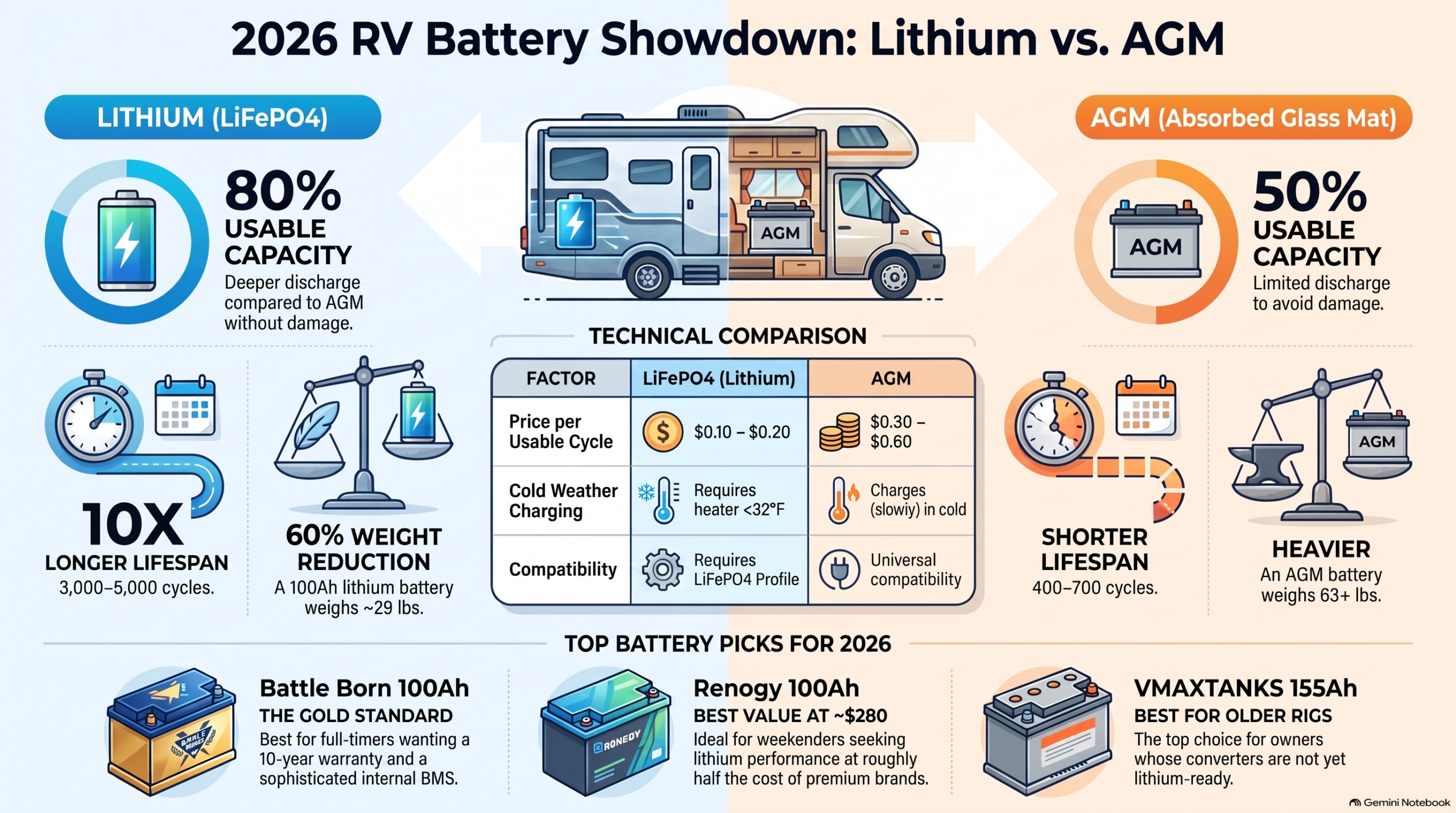
Battle Born has been in the lithium RV game since before it was trendy, and their 100Ah LiFePO4 is still the benchmark. The built-in battery management system (BMS) handles overcharge, over-discharge, short circuit, and temperature protection without add-ons. It delivers 3,000–5,000 cycles at 80% depth of discharge — that’s 8–13 years of daily use. At 29 lbs, it’s a third the weight of a comparable AGM. Drop four of these in a compartment and you have 400Ah usable capacity in a space a conventional battery bank can’t match.
Key specs: 100Ah / 12.8V / 1,280Wh / 29 lbs / 3,000+ cycles / 10-year warranty / rated for enclosed spaces
Watch out for: Won’t accept a charge below 25°F without a battery heater add-on. If you camp in the snow regularly, budget for the heated version or a self-heating blanket.
2. Renogy 100Ah LiFePO4 — Best Value
Who it’s for: Weekend warriors and first-time lithium buyers who want real performance without spending Battle Born money.
Renogy has built a legitimate reputation in solar and battery gear. Their 100Ah LiFePO4 (the Smart version adds Bluetooth monitoring via their app) runs $250–$320 depending on the sale cycle — roughly half the cost of Battle Born for a battery that performs comparably in most weekend-use scenarios. Cycle life is rated at 4,000+ and the BMS is solid. You lose some cold-weather headroom and the warranty drops to 5 years, but for part-time RVers that’s an easy trade.
Key specs: 100Ah / 12.8V / 26.5 lbs / 4,000+ cycles / 5-year warranty / Bluetooth (Smart version)
Watch out for: The non-Smart version has no state-of-charge feedback. Spend the extra $20 for the Bluetooth model so you can see actual capacity, not just guess from voltage.
3. Ampere Time 200Ah LiFePO4 — Best for Boondocking
Who it’s for: Off-grid campers who need serious capacity in a single-battery footprint.
Two 100Ah batteries wired in parallel vs. one 200Ah: the single battery wins on simplicity, especially in tight compartments. Ampere Time (rebranded as LiTime in some markets) builds affordable, reliable LiFePO4 cells. Their 200Ah unit weighs 48 lbs — heavier than two 100Ah lithium batteries individually, but it’s a single unit with one set of terminals and no balancing concerns. At $480–$520, you’re getting 160Ah of usable capacity (80% DOD) for less than two Battle Borns.
Key specs: 200Ah / 12.8V / 48 lbs / 4,000+ cycles / 5-year warranty
Watch out for: Confirm your battery compartment dimensions before ordering. A 200Ah lithium is physically larger than most stock compartments expect. Measure twice.
4. VMAXTANKS 155Ah AGM — Best AGM Option
Who it’s for: RVers with older converters not rated for lithium, or those building a budget house bank they’ll upgrade later.
Not every converter or inverter-charger plays well with lithium. If yours isn’t rated for LiFePO4 charging profiles, forcing it anyway voids your battery warranty and risks cell damage. VMAXTANKS builds a better-than-average AGM — military-grade plates and thicker construction give it longer cycle life than a Walmart deep cycle. You’ll only use about 75Ah (50% DOD to protect longevity), but the price is right and it’s a legitimate bridge option.
Key specs: 155Ah / 12V AGM / ~63 lbs / 500–700 cycles at 50% DOD / 1-year warranty
Watch out for: Heat and partial-state charging kill AGM batteries faster than anything else. If you leave it plugged in at 80% for months at a time, expect early failure.
5. Optima Bluetop D31M — Best Chassis / Starting Battery
Who it’s for: Class A and C motorhomes that need a dedicated chassis or starting battery separate from the house bank.
This isn’t a house battery pick — it’s a starting battery pick. The Optima Bluetop D31M is a dual-purpose AGM with Optima’s spiral cell construction. It cold-cranks reliably and holds up to the vibration that kills conventional plates on diesel rigs. If you’ve been replacing your chassis battery every 2–3 years, this is the upgrade that stops the cycle.
Key specs: 75Ah / 12V / 900 CCA / dual-purpose AGM / 36-month warranty
How to Size Your RV Battery Bank
The most common mistake: buying 100Ah of AGM and wondering why everything goes dead by 9pm. Here’s the math:
- List your loads — fridge (40–60W average), lights (5–30W), phone/laptop charging (20W), fan or furnace blower (15–50W). Sum the watts, divide by 12 to get amps per hour.
- Estimate daily amp-hours — multiply each load’s amps by hours used per day and add everything up.
- Apply DOD factor — you can only use 50% of AGM or 80% of LiFePO4 without damaging the battery. Divide your daily draw by that factor to get minimum battery size.
- Add 20% buffer — for cloudy days, converter inefficiency, and the loads that always creep in.
Example: 60Ah/day of loads, lithium battery at 80% DOD. 60 ÷ 0.80 = 75Ah minimum. Add 20% = 90Ah. A 100Ah lithium covers you with headroom.
Lithium vs. AGM: The Real Comparison
| Factor | LiFePO4 Lithium | AGM |
|---|---|---|
| Usable capacity | 80% of rated | 50% of rated |
| Cycle life | 3,000–5,000+ | 400–700 |
| Weight (100Ah) | 26–30 lbs | 63–70 lbs |
| Charge acceptance | Fast (takes full current to 100%) | Slow (tapers sharply after 80%) |
| Cold weather | Won’t charge below 32°F (without heater) | Charges in cold, just slower |
| Price per usable cycle | $0.10–0.20 | $0.30–0.60 |
| Converter compatibility | Requires LiFePO4 charge profile | Universal |
Frequently Asked Questions
Can I drop a lithium battery into my RV without changing anything else?
Sometimes. Your converter-charger needs a lithium (LiFePO4) charging profile — without it, you’re either undercharging the battery or pushing it past safe limits. Pull the model number off your converter and check the manufacturer’s spec sheet. Most converters made after 2018 have a lithium mode built in; many 2015 and older units don’t.
How long do RV batteries last?
AGM: 3–5 years with proper care. Lithium: 10–15 years. The big killers for AGM are chronic partial-state charging (plugged in at 80% for months at a time), heat, and discharging past 50%. For lithium, heat above 130°F and charging below freezing are the main failure modes.
Do I need a battery monitor?
Yes — the voltage gauge on your RV’s control panel is nearly useless. A shunt-based monitor like the Victron BMV-712 gives you accurate state-of-charge, amp-hours consumed, and time remaining. Especially important with lithium, which has a flat discharge curve that makes voltage estimates almost meaningless.
Can I mix lithium and AGM in the same bank?
No. Different chemistries have different charge profiles, internal resistance, and voltage curves. Mixing them causes one to overcharge while the other undercharges. Keep your battery bank a single chemistry.
Bottom line: If your rig is wired for it, go lithium — the Renogy 100Ah is the easiest entry point and the Battle Born is the one you stop thinking about for a decade. If your charging system isn’t lithium-ready, the VMAXTANKS AGM beats anything from a big-box store. Either way, stop running on the factory battery that shipped with your rig in 2016.