How to Sanitize an RV Fresh Water Tank Without Bleach (2026 Guide)
Bleach works fine for most owners. If you’re not sure why you’re avoiding it, our regular sanitizing guide with bleach may be simpler. Continue if you have a specific reason to skip bleach.
Bleach is the traditional advice for sanitizing an RV fresh water tank, but plenty of owners have good reasons to avoid it. Bleach corrodes stainless steel fittings over time. It degrades rubber seals in pumps, water heaters, and check valves. It leaves a distinct chlorine taste that lingers for weeks. And for owners with lithium water systems, softened water setups, or specific plumbing components, bleach can cause real damage.
The good news: bleach isn’t the only way to sanitize a fresh water tank, and the alternatives are effective, gentler on your system, and easier to flush out afterward.
This guide walks through the three best bleach-free sanitizing methods, when to use each, exact ratios and procedures, and how to know when your tank actually needs sanitizing.
When to Sanitize Your Fresh Water Tank
Before jumping into methods, know when sanitizing is actually needed:
- After winter storage — tanks that sit unused for months develop bacterial growth even when properly winterized
- After buying a used RV — you have no idea what was in the previous owner’s tank
- When water tastes or smells off — sulfur, plastic, or “old” tastes indicate bacterial or microbial buildup
- After the pump has run dry or air has been in the system for extended periods
- Once per year as routine maintenance — even without symptoms, annual sanitizing prevents problems
- After exposure to potentially contaminated water sources — if you filled from a questionable well or camp source
- When the tank has been empty for 3+ weeks — moisture combined with darkness creates ideal bacterial conditions
If none of these apply and your water tastes and smells fine, you probably don’t need to sanitize right now.
Method 1: Hydrogen Peroxide (Recommended for Most Owners)
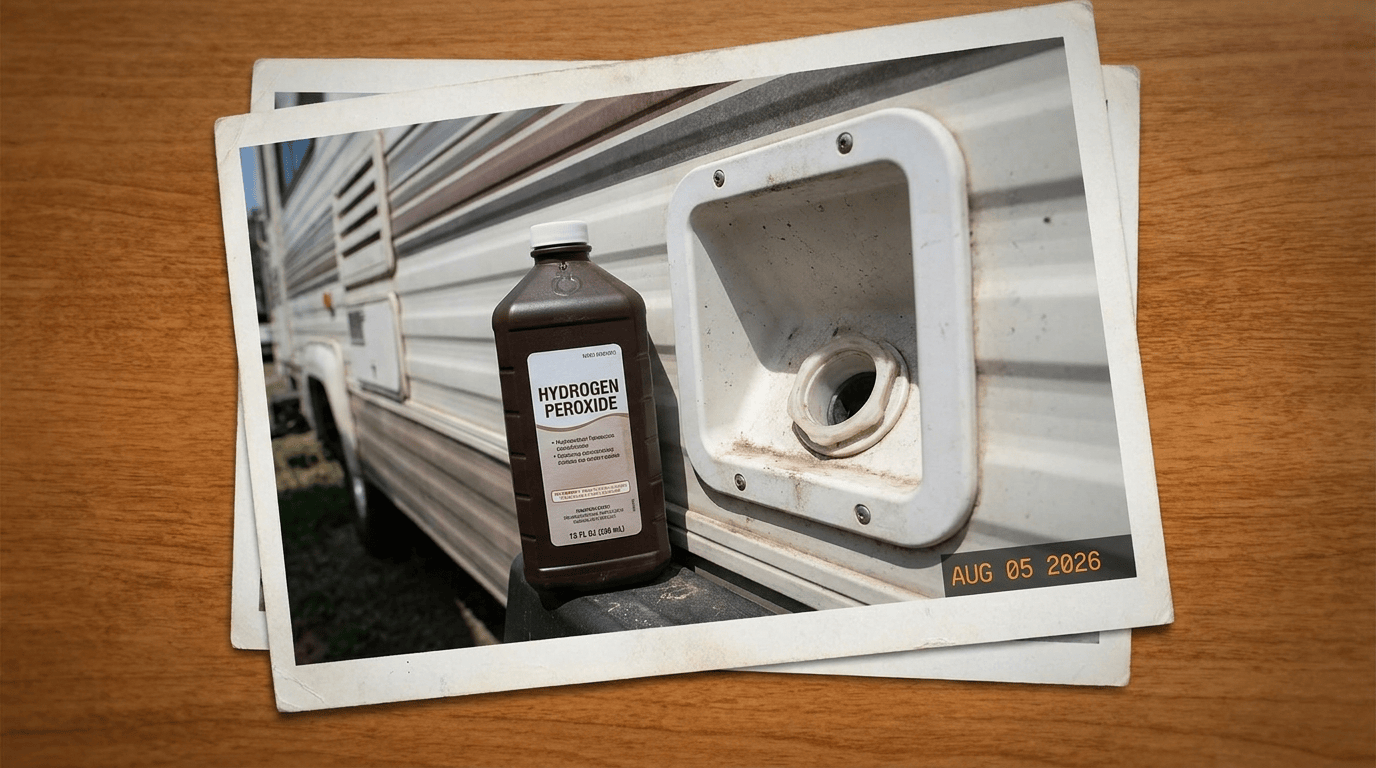
Hydrogen peroxide is the best bleach alternative for most RV owners. It’s effective against bacteria, algae, and biofilm; it’s gentle on RV plumbing components; and it breaks down naturally into water and oxygen with no lingering taste or residue.
What you need:
- Standard 3% hydrogen peroxide from any pharmacy or grocery store
- A funnel
- Enough water to fill your fresh water tank
Ratio:
- 1 pint (16 fl oz) of 3% hydrogen peroxide per 15 gallons of fresh water tank capacity
For example:
- 30-gallon tank: 2 pints (32 oz) of hydrogen peroxide
- 45-gallon tank: 3 pints (48 oz)
- 60-gallon tank: 4 pints (64 oz)
- 100-gallon tank: 6-7 pints (about 3 quarts)
Procedure:
- Drain the tank completely. Open the low point drain and let it fully empty.
- Close the drain and add hydrogen peroxide. Use a funnel to pour the measured amount directly into the fresh water tank fill.
- Fill the tank with water. Fill to about 90% capacity. Don’t overfill — you want room for movement as you drive or slosh the solution.
- Circulate the solution through the system. Turn on the water pump. Open every faucet — kitchen, bathroom sink, shower, toilet, outdoor shower, exterior wash station — one at a time until you smell or see the hydrogen peroxide solution coming through. This ensures the sanitizing solution reaches every pipe, fitting, and valve.
- Let it sit. Close all faucets. Let the solution sit in the tank and lines for 6-12 hours minimum, or overnight for best results.
- Drive if possible. If you can, drive the RV for 15-30 minutes with the tank full. The sloshing helps the solution contact every surface inside the tank.
- Drain thoroughly. Open the low point drain and let the tank empty completely. Open every faucet to drain the lines.
- Flush with fresh water. Refill the tank with fresh water. Run every faucet until the water runs clean. This typically takes 2-3 full tank refills to fully flush.
- Taste test. Draw water from the kitchen faucet. If you can still taste anything unusual, do one more fill-and-flush cycle.
Why hydrogen peroxide works:
Hydrogen peroxide breaks down organic matter through oxidation — the same principle as bleach, but the byproducts are water and oxygen instead of chlorine compounds. It kills bacteria, algae, and biofilm effectively while being genuinely safe for RV plumbing components including rubber seals, plastic fittings, and metal connections.
Cost: About $3-$8 total for pharmacy hydrogen peroxide. Roughly comparable to bleach in cost.
Method 2: White Vinegar (For Mineral Buildup and Mild Sanitizing)
White vinegar is excellent for removing mineral scale, calcium deposits, and mild bacterial buildup. It’s not as strong as hydrogen peroxide for heavy contamination, but it’s gentler and works well for regular maintenance.
What you need:
- Distilled white vinegar (grocery store, standard 5% acidity)
- A funnel
Ratio:
- 1 gallon of white vinegar per 15 gallons of tank capacity
For example:
- 30-gallon tank: 2 gallons of vinegar
- 45-gallon tank: 3 gallons
- 60-gallon tank: 4 gallons
Procedure:
- Drain the tank completely.
- Add the measured white vinegar to the empty tank.
- Fill the tank with fresh water.
- Run the pump and open every faucet to circulate the vinegar solution through all lines.
- Let sit for 12-24 hours for best results.
- Drive for 15-30 minutes if possible.
- Drain the tank completely.
- Flush with fresh water. Vinegar takes 2-4 refills to fully flush the taste out.
When to choose vinegar over hydrogen peroxide:
- Your tank has visible mineral buildup or scale (vinegar dissolves this better)
- You’re doing routine maintenance rather than heavy sanitizing
- You want the gentlest option on RV plumbing
- You’re sensitive to any oxidative chemistry
Downside: Vinegar leaves a taste that takes multiple flushes to fully eliminate. Some owners find this more annoying than the mild chlorine taste from bleach.
Cost: About $8-$15 total depending on tank size and vinegar prices.
Method 3: Commercial RV Water System Sanitizers
Purpose-built RV sanitizing products are formulated specifically for RV water systems. They’re more expensive than hydrogen peroxide or vinegar but offer convenience and specific-purpose formulation.
Popular options:
Camco TastePURE Water System Cleaner and Deodorizer
- Concentrated formula, follow package directions
- Safe for RV plumbing components
- Available at any RV supply store or Amazon
- Cost: $10-$18 per bottle
Star Brite Aqua Clean Water Tank Flush
- Specifically formulated for RV and marine tanks
- Cleans and sanitizes
- Available at RV supply stores and Amazon
- Cost: $12-$25 per bottle
Rally Water Filter System Cleaner
- Cleans filters and tanks together
- Convenient application
- Cost: $8-$15 per bottle
Thetford Aqua-Kem Sanitizer (note: different from their black tank product)
- Focused on freshwater sanitizing
- Cost: $10-$20 per bottle
Procedure:
Follow the specific product’s instructions. Most work similarly to hydrogen peroxide — add to empty tank, fill with water, circulate through system, let sit, flush.
When to choose commercial:
- You want a purpose-built product with clear instructions
- You’re doing multiple sanitizing cycles per year
- Convenience matters more than cost
- You want a product specifically designed for RV plumbing
Downside: Costs 3-5x more than hydrogen peroxide for the same sanitizing effect. Marketing suggests better performance than DIY alternatives, but real-world results are largely equivalent to hydrogen peroxide for typical applications.
Which Method to Use When
Quick decision guide:
Use hydrogen peroxide when:
- Regular annual sanitizing
- After winter storage
- Water tastes or smells off
- Post-purchase used RV cleanup
- You want the most cost-effective and effective option
Use vinegar when:
- Mineral scale is visible in the tank
- Routine maintenance between deeper sanitizings
- You want the gentlest option on plumbing
- You’re sensitive to oxidative chemistry
Use commercial products when:
- Convenience justifies higher cost
- You prefer purpose-built products with specific instructions
- You’re doing frequent sanitizing (more than 2-3 times per year)
What Happens If You Skip Sanitizing
RV owners who never sanitize their fresh water tanks eventually see:
- Bacterial growth producing off-tastes, smells, and potential health issues
- Biofilm buildup on tank interior walls — slick, brown or gray coating that harbors bacteria and clogs pumps
- Mineral scale from hard water accumulating and creating flow restrictions
- Rubber seal degradation from long-term contact with contaminated water
- Pump and appliance issues as sediment and organic matter clog components
Regular sanitizing (once per year minimum) prevents all of these. It’s cheap insurance for a critical system.
Things That Are NOT Substitutes for Sanitizing
Owners sometimes think these are enough. They’re not:
Just filling with fresh water. Fresh water refilling flushes out sediment but doesn’t kill bacteria that have established in the tank.
Water filters. Filters catch contaminants before they enter your rig but don’t clean the tank itself. A dirty tank contaminates any water passing through it.
Bottled water only. Even if you never fill the tank, sitting empty allows bacterial growth in remaining moisture.
Boiling water in the RV. Doesn’t reach fresh water tank contents. Only sanitizes what’s currently at the faucet.
Chlorinated tablets or chlorine additives. Small amounts of chlorine don’t sanitize an entire tank — you’d need the ratios in this guide, and most owners don’t want that level of chlorine anywhere in their water system.
Water conditioner or softener. These prevent mineral buildup but don’t kill bacteria.
Common Sanitizing Mistakes
Skipping the pump-through step. Adding sanitizer to the tank and letting it sit only sanitizes the tank itself. If you don’t run it through the pump and out every faucet, all your lines and appliances retain bacteria.
Not flushing thoroughly. A single fresh-water refill isn’t enough. Most sanitizing methods need 2-4 full flush cycles to fully remove the sanitizing agent taste and smell.
Using too much sanitizer. More is not better. Over-concentrated solutions can damage rubber seals, particularly in the water heater and water pump. Follow ratios.
Using the wrong sanitizer for the situation. Vinegar for heavy bacterial contamination is not effective. Hydrogen peroxide for pure scale removal is overkill. Match the method to the situation.
Not testing the water afterward. Draw water and actually taste it. If you can taste the sanitizer or unusual flavor, flush again.
Sanitizing without checking for leaks first. If you have a plumbing leak, adding sanitizer solution and running the pump forces sanitizer everywhere — including outside the water lines. Fix leaks first, then sanitize.
Not sanitizing the hot water heater. The water heater retains water from the previous fill. Sanitizing must include running the sanitizing solution through the hot water lines. Don’t bypass the water heater during sanitizing.
Frequently Asked Questions
How often should I sanitize my RV fresh water tank?
Once per year minimum. Sanitize more frequently if you notice off-tastes, after winter storage, after buying a used RV, or after the tank has been empty for 3+ weeks.
Is hydrogen peroxide safe for my RV water system?
Yes. Hydrogen peroxide is gentle on rubber seals, plastic fittings, and metal components. It breaks down into water and oxygen — no residue or corrosion issues that bleach can cause over time.
Can I use higher-strength hydrogen peroxide?
Standard 3% pharmacy hydrogen peroxide is what these ratios are calibrated for. Higher strengths (food-grade 35% or medical-grade 12%) are more concentrated but potentially damaging if not diluted properly. Stick with 3% pharmacy grade.
Will vinegar remove all bacteria?
Vinegar kills common bacteria and mild contamination, but it’s less effective than hydrogen peroxide for heavy bacterial growth. For post-storage or post-used-purchase cleaning, use hydrogen peroxide. For routine maintenance, vinegar works fine.
Can I mix hydrogen peroxide and vinegar?
No. When combined, hydrogen peroxide and vinegar create peracetic acid, which is corrosive and potentially harmful to breathe. Use one or the other, not both together.
Does bleach really damage RV plumbing?
Yes, but slowly. Bleach corrodes stainless steel over time, degrades rubber seals in pumps and appliances, and can react with certain plastics. Occasional bleach use won’t destroy your system, but regular bleach use accelerates component wear. Hydrogen peroxide is genuinely gentler.
How do I know if my tank is actually clean?
Draw water from your kitchen faucet after flushing. Water should be clear, odorless, and tasteless. If you notice any off-flavor, smell, or discoloration, do another flush cycle.
What if my water still tastes bad after sanitizing?
Multiple issues could be at play: incomplete flushing, contamination in the source water, hard water minerals, or an issue with a specific component (aged water heater, contaminated filter). Try one more thorough flush cycle. If problems persist, the issue is likely a component, not the tank.
Can I sanitize while camping or do I need to be at home?
You need access to a drain area where you can discharge the sanitizing solution. Doing this at a campground with a dump station and full hookup is straightforward. Boondocking or dry camping makes sanitizing harder.
Should I sanitize the black or gray tanks too?
Yes, but with different products. Black tank sanitizing uses purpose-built products designed for waste tanks. Gray tank sanitizing is similar. Don’t use fresh water tank sanitizer on waste tanks — different chemistry and purpose.
Is baking soda a good sanitizer?
Baking soda is not a sanitizer. It’s a mild cleaner and deodorizer. It doesn’t kill bacteria effectively. Don’t use it as a fresh water tank sanitizer alternative.
Can I use pool sanitizer or hot tub chlorine?
Absolutely not. Pool sanitizers contain different chlorine compounds and stabilizers that are not safe for potable water systems. Stick to bleach (if you must), hydrogen peroxide, vinegar, or RV-specific commercial products.
How long can I go between sanitizing if I use a water filter?
Water filters catch contaminants before they enter your rig but don’t clean the tank itself. Filter usage doesn’t extend the sanitizing interval. Annual sanitizing remains the standard regardless of filter use.
Bottom line: Bleach isn’t necessary to properly sanitize your RV fresh water tank. Hydrogen peroxide (1 pint per 15 gallons) is the best all-around alternative — effective, gentle on plumbing, and breaks down cleanly. Vinegar works for maintenance and mineral removal. Commercial products offer convenience at higher cost. Whichever method you choose, the fundamentals are the same: add sanitizer to an empty tank, fill with water, circulate through every faucet, let sit for 6-12 hours, then flush thoroughly with fresh water.
Water System Issues Beyond DIY?
Search the RV Repair Lab directory for Lab-Vetted mobile techs and shops that handle plumbing issues, tank problems, or water quality concerns. Filter by plumbing specialization.