
RV Water Heater Repair: The Complete Diagnostic Guide
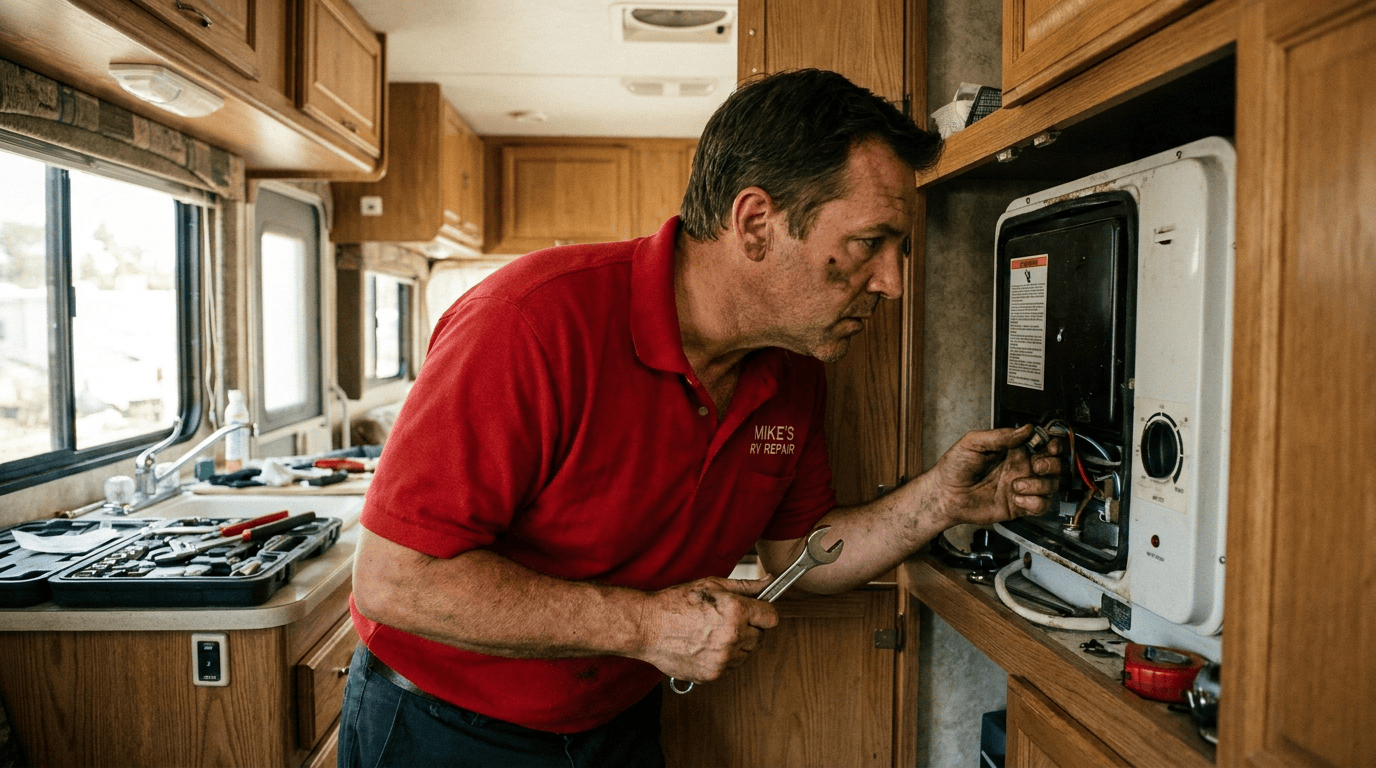
Cold showers are the second-worst RV surprise. (Slide-outs won that ranking.) One morning your water heater works fine, the next morning you’re standing in a stream of ice water at 6am realizing that today was supposed to be a driving day and now you have a problem instead.
RV water heater failures fall into a small set of common causes — and most are diagnosable in about 20 minutes with basic tools. Some you can fix yourself for $10–$80 in parts. Others require a tech. But before you authorize any repair estimate, you should know what’s actually wrong, what a fair fix costs, and whether repair even makes sense given your unit’s age.
This guide walks you through the three main types of RV water heaters, symptom-to-cause diagnostics, DIY repairs you can handle, when to call a pro, and what real replacement costs in 2026.
First: Know What Kind of Water Heater You Have
Three main types are common in RVs, and they fail differently, are repaired differently, and cost different amounts.
Suburban Water Heaters
The traditional RV standard, made by Airxcel/Suburban. Tank-based, runs on propane and/or 120V AC electric, uses a steel tank with an anode rod for corrosion protection.
Identification: Look at the exterior access door. Suburban units have “Suburban” printed on the door and use a threaded hex-head anode rod (usually 1-1/16″ head) at the bottom of the tank.
Common sizes: 6-gallon, 10-gallon, 12-gallon, 16-gallon.
Common models: SW6, SW10, SW12, SW16 (plus suffixes for various configurations).
Suburban units are widely serviceable, parts are inexpensive and available, and repairs are mostly DIY-friendly. If you’re picking a water heater for reliability and repairability, this is the standard.
Atwood / Dometic Water Heaters
Atwood was acquired by Dometic in 2014, so newer units say Dometic on them but function similarly to older Atwood designs. Aluminum-lined tank (no anode rod needed), similar tank-based design otherwise.
Identification: “Dometic” or “Atwood” printed on the exterior door. No anode rod — instead, a plastic drain plug at the bottom.
Common sizes: 6-gallon, 10-gallon.
Common models: GC6AA, GC10A, GCH6A, GCH10A, and various Dometic-branded successors.
Atwood/Dometic units generally fail differently than Suburban — no anode rod means no anode-related corrosion issues, but the aluminum tanks are more prone to leaking when they eventually fail, and repair options are more limited.
Tankless Water Heaters (Truma, Girard, Furrion)
Newer technology increasingly common in modern rigs. No tank — water heats on-demand as it flows through a heat exchanger. Runs on propane; some models add 120V electric assist.
Identification: Compact exterior door, often smaller than tank units. Brand name (Truma AquaGo, Girard On-Demand, Furrion) printed on the door.
Common brands: Truma AquaGo, Girard 2GWHAM, Furrion FWH.
Tankless units cool faster, provide continuous hot water (until propane runs out), and take up less storage space. But they’re more expensive, more complex to repair, and fail differently than tank-based units. Different diagnostic tree entirely.
Symptoms and What They Mean
Match your symptom to the most likely cause. This narrows the diagnostic tree fast.
No hot water at all
- Water heater bypass valve accidentally on (winterization mode) — surprisingly common
- Failed heating element (electric side)
- Failed gas valve or ignition (propane side)
- Blown thermal fuse
- Failed thermostat
- Wire connection failure
Won’t ignite on propane
- Empty propane tank or closed shutoff valve
- Blocked burner orifice (spider webs are the #1 cause — really)
- Failed thermocouple (older units)
- Failed gas valve
- Failed circuit board or ignition module
- Bad exterior door flame sensor
Ignites but won’t stay lit
- Bad thermocouple (traditional pilot systems)
- Weak gas pressure
- Failed flame sensor
- Blocked exhaust or intake
Works on propane but not electric
- Blown thermal fuse on the electric side
- Failed heating element
- Failed thermostat (electric side)
- Circuit breaker tripped
- Wire connection issue
Works on electric but not propane
- Empty propane
- Failed gas valve
- Failed ignition module
- Bad thermocouple
- Blocked burner assembly
Water leaks from bottom
- Suburban: Anode rod corroded away (this is normal — replace annually)
- Atwood/Dometic: Failed drain plug seal (replace plug and washer)
- Any: Tank corrosion/rust-through (major failure — usually requires replacement)
Water leaks from top or side
- T&P (temperature and pressure) relief valve dripping — could be normal thermal expansion or failing valve
- Failed inlet or outlet fitting
- Cracked plastic housing (some models)
- Freeze damage from missed winterization
Rusty or discolored water
- Suburban: Anode rod completely consumed, tank starting to corrode — replace anode ASAP
- Atwood/Dometic: Tank interior corrosion — often signals coming failure
- Any: Sediment buildup — flush the tank
Sulfur / rotten egg smell
- Anode rod reacting with sulfur in water supply — swap magnesium anode for aluminum-zinc
- Bacterial growth in tank — flush and sanitize with hydrogen peroxide
Popping, cracking, or knocking sounds
- Sediment buildup in tank — flush needed
- Scale on heating element
- Tank pressure fluctuation (usually not a real problem)
Water too hot
- Failed thermostat (stuck on)
- Failed high-limit switch
Water not hot enough
- Weak burner (dirty or blocked)
- Weak heating element (partial failure)
- Undersized unit for demand (some 6-gallon units run out fast)
- Thermostat set too low
The 20-Minute Diagnostic Checklist
Before calling anyone, run through this.
1. Check the bypass valves.
Look under your kitchen sink or wherever your water heater access panel is inside. If the water heater was winterized, there are bypass valves that route water around the tank. If these are still in bypass mode, no water flows through the heater regardless of whether it’s working.
Turn all bypass valves to normal position (parallel with the pipes). Run hot water for 60 seconds to fill the tank. Try heating again.
This is genuinely the #1 “my water heater died” cause after de-winterizing in spring. Check it first.
2. Verify power and gas supply.
- Is 120V shore power connected and the water heater breaker on?
- Is the propane tank open and not empty?
- Is the propane detector alarming (indicating gas issue)?
- Are there other propane appliances working (stove, furnace)? If yes, propane supply is fine.
3. Listen and observe when you switch the unit on.
- Electric side: You should hear a subtle click and then silence (element heating).
- Propane side: You’ll hear a whirring or clicking as the ignition tries. Then either a whoosh of ignition or continued clicking without success.
Match what you hear to the symptom list above.
4. Check the exterior burner assembly (propane).
Open the outside access door. Look at the burner assembly with a flashlight. Spider webs blocking the burner tube or orifice are extremely common — spiders love the smell of mercaptan (the additive that gives propane its smell) and build webs inside burner assemblies.
Signs of spider webs or dirt obstruction:
- Visible webs in the burner tube
- Yellow or orange flame instead of blue (partial obstruction)
- Popping ignition sounds
- Slow ignition or repeated failed attempts
Clean the burner assembly with compressed air or a soft brush. This alone resolves 30% of propane ignition problems.
5. Check the electric heating element (electric issues).
Turn off shore power and remove the exterior cover on the electric element (Suburban units — one screw usually). Check for:
- Corrosion on the wire connections
- Visible damage to the element
- Continuity with a multimeter (element should read 10–15 ohms; open circuit = failed element)
Do NOT test elements with power connected. Always disconnect first.
6. Check the thermal fuse (electric side).
Suburban and most units have a thermal fuse on the electric side that blows if the element overheats (often from running dry). Fuses look like small cylindrical devices with two wires — a blown fuse shows open on the multimeter and is a $5 replacement.
Thermal fuse blows are often a symptom of a bigger problem — usually running the element dry. Fix the root cause, don’t just keep replacing fuses.
7. Check the thermocouple (older propane units).
If you have an older Suburban with a pilot light system, a bad thermocouple is a common failure. The thermocouple is a metal probe positioned in the pilot flame that generates voltage to keep the gas valve open. Corroded or failed thermocouples cause the pilot to light briefly then extinguish when you release the button.
Modern electronic ignition systems (post-2010 mostly) don’t have traditional thermocouples — they use flame sensors instead.
8. Check the anode rod (Suburban).
Turn off water, drain the tank, remove the anode rod. If it’s more than 75% consumed, replace it ($15–$25 for a new one). Consumed anode rods contribute to tank corrosion and can cause rusty water.
If the anode rod is completely gone or the tank has visible interior rust, the tank itself may be near failure.
9. Check the T&P valve.
The temperature and pressure relief valve is safety equipment — it opens if pressure gets dangerously high. Occasional dripping during heating cycles is normal (thermal expansion). Continuous dripping or streaming water indicates a bad valve ($20–$40 replacement).
10. Test with a manual override.
Some Suburban units have a manual reset button behind the exterior cover. If the unit tripped on a safety cutoff, pressing this button can restore function. Check your specific model’s manual.
DIY Repairs You Can Handle
Several water heater repairs are within reach for a mechanically-inclined owner.
Anode Rod Replacement (Suburban Only, Annual Maintenance)
Difficulty: Easy
Time: 20–30 minutes
Cost: $15–$25
The anode rod is designed to be sacrificial — it corrodes so the tank doesn’t. Replace it annually or when it’s 75% consumed.
Procedure:
- Turn off water heater, wait for it to cool completely (several hours)
- Turn off water pump and city water inlet
- Open the T&P valve to release pressure
- Place a bucket under the anode rod location (usually accessible from exterior door)
- Use a 1-1/16″ socket to unscrew the anode rod slowly
- Water will drain — that’s expected
- Once drained, remove the old rod completely
- Wrap new anode rod threads with Teflon tape (2–3 wraps)
- Install new rod, tighten firmly but don’t over-torque
- Close T&P valve, refill tank, check for leaks
Anode rod choice: Magnesium rods are the default. If you have persistent sulfur/rotten egg smell in your hot water, switch to an aluminum-zinc rod — it doesn’t react with sulfur bacteria the same way.
Burner Assembly Cleaning (Propane Ignition Issues)
Difficulty: Easy
Time: 15–20 minutes
Cost: $0
Procedure:
- Turn off propane and water heater
- Open exterior access door
- Identify the burner tube — the long tube leading to the burner
- Remove any visible debris, spider webs, or dirt
- Compressed air (short bursts) through the burner tube clears most obstructions
- Wipe the burner and flame sensor clean with a soft cloth
- Reassemble and test
Bug screens installed over the burner intake help prevent recurrence — $10–$15 aftermarket accessory worth adding.
Thermal Fuse Replacement
Difficulty: Easy-medium
Time: 20–30 minutes
Cost: $5–$15
Procedure:
- Turn off all power to the water heater
- Remove exterior cover
- Identify the thermal fuse (usually near the heating element on the electric side)
- Test with multimeter — should read continuity (0 ohms). Open circuit = blown.
- Disconnect wires (note position)
- Unscrew or clip out the old fuse
- Install new fuse of exact same rating
- Reconnect wires, reassemble
- Restore power and test
Important: if a thermal fuse blows, find out why before repeatedly replacing it. Most commonly the element ran dry (tank wasn’t full) and overheated. Fill tank fully before energizing again.
Heating Element Replacement (Electric Side)
Difficulty: Medium
Time: 45–60 minutes
Cost: $30–$80
Procedure:
- Turn off all power to water heater
- Turn off water, drain tank completely
- Remove exterior cover on the electric element
- Disconnect element wiring (note connections)
- Use element wrench (special socket, ~$15 or borrowed) to unscrew element
- Install new element with new gasket, wrap threads with Teflon tape
- Tighten firmly
- Reconnect wiring
- Refill tank COMPLETELY before restoring power (running element dry = instant failure)
- Verify no leaks, then energize
Never energize an electric element with an empty or partially filled tank. The element must be fully submerged in water.
T&P Valve Replacement
Difficulty: Medium
Time: 30 minutes
Cost: $20–$40
Procedure:
- Turn off water heater, drain slightly
- Locate T&P valve (usually on top of tank)
- Unscrew old valve with pipe wrench
- Apply Teflon tape or thread sealant to new valve
- Screw in new valve
- Refill tank, check for leaks
Thermostat Replacement
Difficulty: Medium
Time: 30–45 minutes
Cost: $25–$50
Procedure varies by specific model. Consult your unit’s service manual.
Pro Territory Repairs
Some water heater work is best left to a mobile tech or shop.
Gas valve replacement. Involves live propane connections and proper leak testing. Not worth risking on your first attempt.
Circuit board / ignition module replacement. Requires specific diagnostic knowledge and often requires calibration.
Complete water heater replacement. Involves plumbing, propane, electrical, and structural work — plus proper disposal of the old unit. Doable DIY for a skilled owner but usually more efficient to hire.
Tankless system repairs. Truma, Girard, and Furrion tankless units require specialized training. Most mobile techs aren’t trained on these; get a manufacturer-certified tech if possible.
Tank replacement. If the tank itself is corroded through, replacement is the only option. Repair is not economically viable for a rusted-out tank.
Freeze damage. If your water heater froze because you missed winterization, expect a full replacement plus potentially additional plumbing repair. This is one of the most expensive winterization-related failures.
What RV Water Heater Repair Costs in 2026
Realistic 2026 cost ranges:
| Repair | Parts | Labor | Total |
|---|---|---|---|
| Anode rod replacement (Suburban) | $15 – $30 | $80 – $150 | $95 – $180 |
| Anode rod DIY | $15 – $30 | $0 | $15 – $30 |
| Burner assembly cleaning | $0 – $20 | $100 – $200 | $100 – $220 |
| Thermal fuse replacement | $5 – $20 | $100 – $200 | $105 – $220 |
| Heating element replacement | $30 – $80 | $150 – $250 | $180 – $330 |
| Thermocouple replacement | $20 – $50 | $100 – $200 | $120 – $250 |
| T&P valve replacement | $20 – $40 | $100 – $180 | $120 – $220 |
| Gas valve replacement | $150 – $400 | $200 – $400 | $350 – $800 |
| Ignition module / circuit board | $200 – $500 | $150 – $300 | $350 – $800 |
| Thermostat replacement | $25 – $75 | $150 – $250 | $175 – $325 |
| Complete water heater replacement (6-gal Suburban) | $400 – $700 | $250 – $500 | $650 – $1,200 |
| Complete water heater replacement (10-gal Suburban) | $500 – $850 | $250 – $550 | $750 – $1,400 |
| Complete water heater replacement (Atwood/Dometic 6-gal) | $450 – $750 | $250 – $500 | $700 – $1,250 |
| Complete water heater replacement (Atwood/Dometic 10-gal) | $550 – $900 | $300 – $600 | $850 – $1,500 |
| Tankless upgrade (Truma AquaGo) | $1,400 – $2,200 | $500 – $900 | $1,900 – $3,100 |
| Tankless repair (Truma, Girard, Furrion) | Varies widely | $200 – $500 | $300 – $1,500 |
| Freeze damage repair | Varies | $300 – $800 | Often full replacement |
Mobile tech pricing is typically comparable to shop labor with a service call fee added. Dealership pricing runs 30–50% higher than mobile or independent shops.
When to Repair vs When to Replace
Repair when:
- Unit is under 8 years old
- Failure is a specific component (element, fuse, thermostat, valve)
- Repair cost is under 40% of replacement cost
- The tank itself is in good condition (no rust, no leaks, anode rod recently replaced)
Replace when:
- Unit is over 12 years old and failing
- Tank shows interior corrosion or is leaking
- This is the second or third significant failure in three years
- Repair cost exceeds 50% of replacement
- You want to upgrade (tank size, add electric, switch to tankless)
Consider tankless upgrade when:
- Current unit is dying and you’re replacing anyway
- You have 120V shore power most of the time
- You value continuous hot water over the delay of a tank refilling
- You’re okay with the higher upfront cost ($1,400–$2,200 unit cost)
Tankless has downsides: higher cost, more complex repair when it fails, requires stable water pressure (some issues with well or low-pressure supplies). Not always the right choice.
Tankless-Specific Considerations
Since tankless is increasingly common, worth calling out specific issues:
Truma AquaGo:
- Requires 12V power to operate even on propane
- Sensitive to water pressure and flow rate
- Has an anti-scaling procedure (essentially a citric acid flush) that should be performed annually
- Common failure: flow sensor, control board, or heat exchanger
Girard On-Demand:
- Less finicky than Truma but heats less efficiently
- Common failure: ignition module, temperature sensor
- Repair parts widely available
Furrion FWH:
- Newer product line
- Repair options more limited due to smaller service network
- Manufacturer support has improved recently
If your rig has tankless from the factory, find a tech familiar with your specific brand before committing to major work. General RV techs often don’t know these systems well.
Preventive Maintenance That Actually Matters
Water heaters last dramatically longer with basic maintenance. Priorities:
Annually:
- Replace anode rod (Suburban) — $15 protects a $1,000 tank
- Flush tank thoroughly to remove sediment
- Clean burner assembly (remove spider webs, check flame color)
- Inspect exterior for corrosion or leaks
- Test T&P valve by manually opening briefly
Before winter storage:
- Complete winterization (drain tank, blow lines, or add antifreeze)
- Never leave water in the tank through freezing weather
- Store with element bypass in place
Before spring use:
- Move bypass valves back to normal position
- Fill tank completely before energizing element
- Run water through the system to flush
- Sanitize the fresh water system if the tank sat unused
Tankless-specific:
- Truma requires annual descaling with citric acid
- All tankless: inspect and clean the filter regularly
Missed winterization is one of the top three causes of water heater failure. Take it seriously.
Frequently Asked Questions
How long should an RV water heater last?
Well-maintained Suburban units last 10–15 years. Atwood/Dometic units 8–12 years. Tankless units 8–12 years so far (technology is newer, long-term data still developing). Neglected units fail dramatically sooner — often 4–6 years.
Why does my RV hot water smell like rotten eggs?
Sulfur bacteria reacting with the magnesium anode rod. Switch to an aluminum-zinc anode rod and the smell usually disappears within a week. Also flush the tank and consider a hydrogen peroxide sanitize.
Can I use a Suburban anode rod in an Atwood water heater?
No. Atwood/Dometic units use aluminum-lined tanks and don’t have (and shouldn’t have) anode rods. There’s a plastic drain plug where the anode would be on a Suburban.
How much does it cost to replace an RV water heater?
$650–$1,400 total for tank-based Suburban or Atwood units, including labor. $700–$1,500 for Atwood/Dometic. $1,900–$3,100 to upgrade to tankless. Prices vary by region and unit size.
Should I upgrade to a tankless water heater?
Depends on your usage pattern. If you camp with shore power most of the time and value continuous hot water, tankless is worth considering. If you’re a boondocker with limited electrical capacity or you rarely notice tank refill delays, tank-based is often the better choice.
Why does my water heater work on propane but not electric?
Most common causes: tripped circuit breaker, blown thermal fuse, failed heating element, or bad wire connection. Diagnose in that order — breaker and fuse are cheap and easy to check first.
Why does my water heater work on electric but not propane?
Most common causes: empty propane, blocked burner (spider webs), failed thermocouple (older units), or failed ignition module. Check propane supply first, then clean burner assembly.
Can I replace my Suburban with an Atwood or vice versa?
Sometimes, but not always. Suburban and Atwood units have different mounting patterns, different plumbing connections, and different electrical wiring. Direct replacements are usually easier when staying with the same brand. Cross-brand swaps often require adapter kits or modifications.
How do I winterize my RV water heater?
Two methods: (1) drain the tank and blow out the lines with compressed air, or (2) use RV antifreeze. Either way, the water heater must be drained and cannot be left with water inside during freezing temperatures. Bypass valves route water around the tank so antifreeze doesn’t fill (and waste) the tank interior.
My water heater is leaking from the bottom. What’s wrong?
Suburban: usually a corroded anode rod that’s leaking around its threads. Replace the anode rod first. If leaking continues, the tank itself may be failing.
Atwood/Dometic: usually a failed drain plug seal. Replace the plug and washer. If leaking continues, tank may be failing.
If replacing the anode/plug doesn’t fix it, the tank has likely failed and needs replacement.
Should I install a mixing valve?
A tempering (mixing) valve mixes cold water into the hot water output, letting you set the tank to a higher temperature (which extends effective capacity) while delivering safe usable temperature at the taps. Popular retrofit that effectively increases hot water capacity by 30-50%. Worth it if you frequently run out of hot water. Cost: $40–$100 for the valve plus installation.
Bottom line: RV water heater failures are mostly diagnosable and fixable if you understand which type you have and match your symptom to the likely cause. Annual anode rod replacement (Suburban) and burner cleaning solve 80% of common problems before they start. When repair is needed, most fixes are under $250 total. Complete replacement runs $650–$1,500 for tank units or $1,900–$3,100 for a tankless upgrade. Skip the dealership; a mobile tech is faster and cheaper.
Water heater beyond DIY?
Search the RV Repair Lab directory for Lab-Vetted mobile techs and shops that service Suburban, Atwood, Dometic, Truma, Girard, and Furrion water heaters. Filter by brand experience and system specialization.
Find a water heater specialist near you →