How Long Do RV Batteries Last? (By Type + What Kills Them)
How long your RV battery lasts depends more on how you treat it than what brand you buy. An AGM battery that gets discharged to zero repeatedly might last a year. The same battery, properly maintained and never taken below 50%, can last 5–6 years. Here’s a realistic look at battery lifespan by type, what kills batteries early, and how to get the most out of whatever you have.
RV Battery Lifespan by Type
| Battery Type | Expected Lifespan | Cycle Life | Usable Depth of Discharge |
|---|---|---|---|
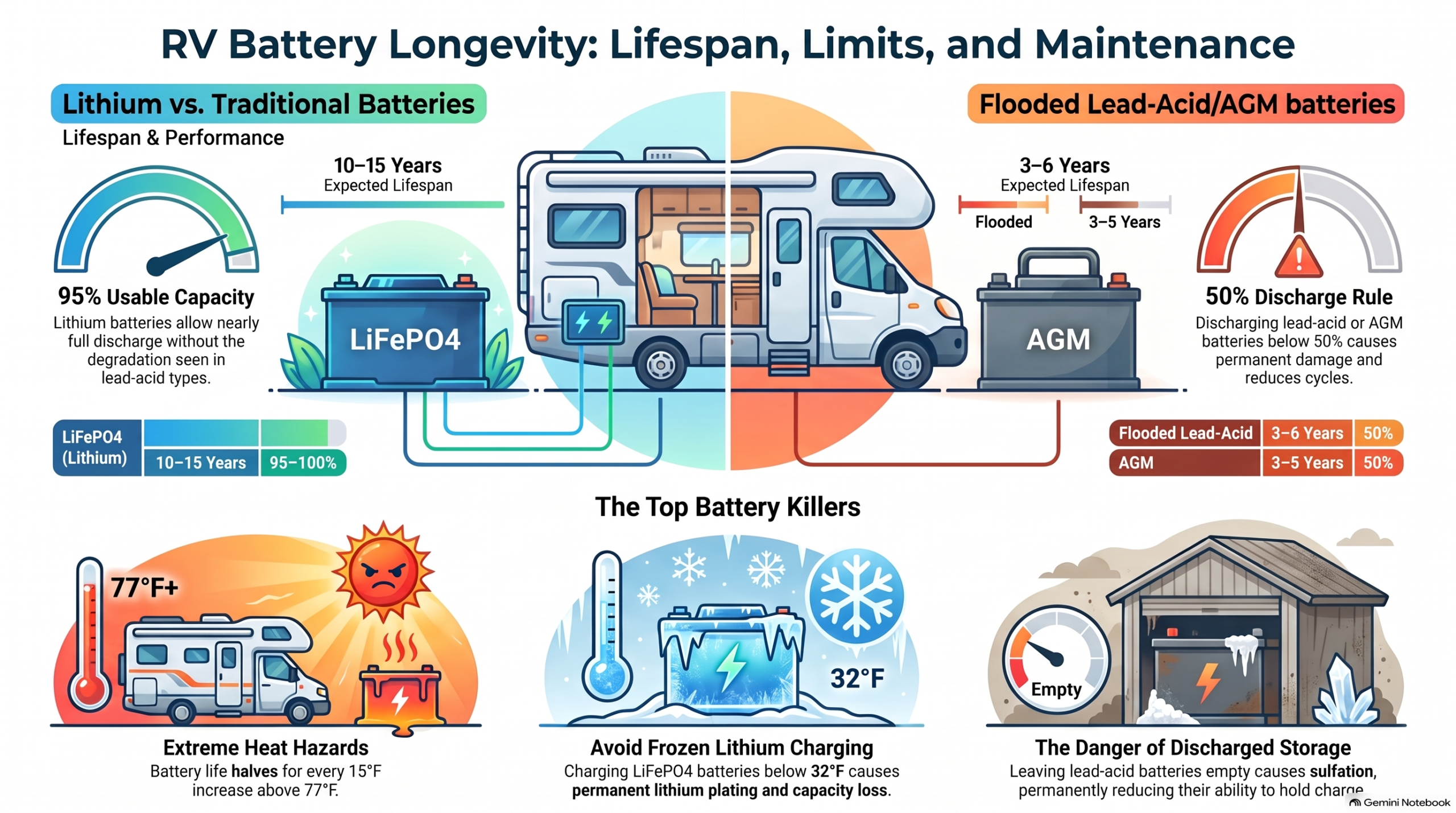
| Flooded lead-acid (FLA) | 3–6 years | 200–400 cycles | 50% |
| AGM | 3–5 years | 400–700 cycles | 50% |
| Gel | 4–6 years | 500–900 cycles | 50% |
| LiFePO4 (lithium) | 10–15 years | 4,000–15,000 cycles | 95–100% |
A “cycle” is one complete discharge and recharge. If you camp every weekend and fully cycle your battery each trip, that’s roughly 50–60 cycles per year. At that rate, a 500-cycle AGM battery lasts about 8–10 years of weekend use. But if you boondock for a week at a time and cycle your battery daily, that’s 365 cycles per year — and your AGM is done in 1–2 years.
What Kills RV Batteries Early
Deep Discharging Below Recommended Levels
This is the number-one battery killer. AGM and lead-acid batteries are seriously damaged by discharges below 50% state of charge (SOC). Every time you pull an AGM below 50%, you reduce its total cycle life. Discharge to 20% repeatedly and you might get 100–200 cycles instead of 500. LiFePO4 batteries tolerate deep discharges much better — they’re designed to cycle to 20% or lower without significant degradation.
Sitting in a Discharged State
Lead-acid batteries left in a discharged state undergo sulfation — lead sulfate crystals form on the plates and permanently reduce capacity. Even a few weeks fully discharged can do measurable damage. Always store your RV with batteries at full charge or connected to a battery tender. A discharged AGM sitting in a storage lot all winter may never recover full capacity.
Overcharging and High Voltage
AGM batteries overcharged above 14.7V cook the electrolyte and accelerate plate corrosion. For lithium, charging above the BMS cutoff (typically 14.6V) trips the protection circuit and repeated trips degrade the BMS over time. Most quality chargers and converters regulate voltage correctly, but a faulty converter can silently overcharge batteries for months.
Extreme Heat
Heat is an accelerant for battery degradation. An AGM battery stored or operated in a 100°F+ battery compartment will degrade significantly faster than one kept cool. For every 15°F increase above 77°F, battery life roughly halves. This is a real concern for rigs parked in the Arizona sun with batteries in unventilated compartments.
Charging Lithium Below Freezing
This one’s specific to LiFePO4: charging below 32°F causes lithium plating on the anode, which permanently reduces capacity. A single hard freeze charge event might cause 5–10% capacity loss. Repeated cold-weather charging without heating causes progressive degradation. If you camp in freezing temperatures, either buy a self-heated lithium battery (like the Power Queen Low-Temp Smart) or use a battery heater pad.
How to Make Your RV Battery Last Longer
For AGM/Lead-Acid Batteries
- Never discharge below 50% SOC (12.1V at rest)
- Recharge promptly after each use — don’t leave discharged batteries sitting
- Store at full charge with a battery tender connected
- Keep them cool — insulate compartments from extreme heat
- For flooded batteries: check water levels monthly and top up with distilled water
- Equalize flooded batteries quarterly (NOT AGM — AGM should not be equalized)
For Lithium (LiFePO4) Batteries
- Don’t charge below 32°F (use self-heated battery or external heater pad)
- Store long-term at 50–80% SOC rather than 100% — reduces cell stress
- Keep within the rated temperature range (most are rated to –4°F for discharge)
- Use a properly configured charger — 14.4V absorption, no equalization
- Don’t exceed the BMS continuous current rating with your inverter or loads
Signs Your RV Battery Is Failing
- Capacity loss: Battery that used to run your fridge for two days now runs it for one. This is the clearest sign of degradation.
- Slow to charge: Takes significantly longer to reach full charge than it used to, or refuses to hold above 80% SOC.
- Voltage sag under load: Voltage drops sharply when you turn on the microwave or air conditioner. On AGM, this starts happening below 12.2V at rest.
- Won’t hold charge: Battery reads full but discharges in hours with no load (standing discharge). Points to internal leakage or shorted cells.
- Physical swelling or leaking: On any battery type, physical deformation or leaking electrolyte means immediate replacement. Don’t use a swollen battery.
When to Replace Your RV Battery
Replace your battery when it holds less than 70–80% of its original capacity. For a 100Ah battery, that’s when you can only get 70–80Ah out of it before it hits cutoff. Most RVers notice this as their appliances running noticeably shorter runtimes than when the battery was new.
If you’re already replacing a failed AGM battery, this is the right moment to make the switch to lithium. You’ll spend a bit more upfront but won’t repeat this replacement for 10–15 years. The Redodo 12V 100Ah (~$270) and Power Queen 100Ah are both direct AGM replacements that drop into existing trays.
FAQ
How long do RV batteries last in storage?
AGM batteries self-discharge at 3–5% per month. Without a maintainer, a fully charged AGM will be dangerously low in 4–6 months. Connect a smart battery tender before storage and check voltage every 2–3 months. LiFePO4 batteries self-discharge at 1–3% per month and can safely sit for a year if stored at 50–80% SOC.
Can a dead RV battery be revived?
Sometimes. A deeply discharged flooded or AGM battery can sometimes be recovered with a slow 2–4A desulfation charge over 24–48 hours. Many quality chargers have a recovery or desulfation mode for this. But if the battery has been sitting discharged for months, or if it shows physical damage, recovery is unlikely and replacement is the safer call. Lithium batteries that have tripped BMS protection can usually be recovered by applying a controlled charge — check your battery’s manual for the reactivation procedure.
Does cold weather shorten RV battery life?
Yes, cold reduces battery performance in the short term — a lead-acid battery at 0°F has roughly 40% of its room-temperature capacity. But cold doesn’t accelerate long-term degradation for AGM or lead-acid; in fact, cooler storage temperatures slow chemical degradation. The exception is lithium: charging below freezing permanently damages LiFePO4 cells. Cold discharge is fine; cold charging is not.
Bottom line: AGM batteries realistically last 3–5 years with good care; lithium lasts 10–15. The biggest factor in lifespan isn’t brand — it’s how deeply you discharge and how promptly you recharge. If your battery is struggling, see our best lithium RV battery guide for replacement picks that won’t need replacing again for a decade.