Best RV Battery for Dry Camping (2026) — RVRepairLab
Most RVs leave the factory with one 12V lead-acid battery, about 50 usable amp-hours. That is one night of lights and furnace fan before you’re running the generator. If you want to dry camp for more than a night, the battery is the first thing to upgrade.
This guide does the math first. You’ll see how much battery your trip actually needs, then which lithium systems from Bluetti, Jackery, Anker SOLIX fit each type of dry camper. Two kinds of product are on the list. Some are built-in systems that replace your house battery. Others are portable power stations you plug your shore cord into.
Quick Picks: Best RV Batteries for Dry Camping (2026)
| Pick | Best for | Capacity | Brand-store price (Nov 7, 2026) |
|---|---|---|---|
| Bluetti RV5 5kWh RV Kit | Best overall built-in system | 5,120Wh (expandable to 122kWh) | $3,699 (reg. $3,999) |
| Jackery HomePower 3000 | Best plug-and-play for travel trailers | 3,072Wh | $1,499 |
| Jackery Explorer 5000 Plus | Best for week-long boondocking | 5,040Wh (expandable to 60kWh) | $3,499 (sold out; pre-orders ship Nov 28) |
| Bluetti Elite 200 V2 | Best budget pick for weekenders | 2,073Wh | $899 |
| Anker SOLIX C2000 Gen 2 | Best lightweight trailer pick | 2,048Wh (expandable to ~4kWh) | $1,199.99 (backordered; ships Nov 21) |
| Anker SOLIX F3800 Plus | Best for big rigs and big solar | 3,840Wh (from 7,680Wh with one expansion battery) | Sold out at Anker SOLIX |
Prices are from each brand’s own store, checked November 7, 2026. They move weekly in this category, so check the live price before you buy.
How Much Battery Do You Need for Dry Camping?
Capacity is the decision that matters most. Buy too little and you’re rationing power by day two. Buy too much and you’ve spent $2,000 on capacity you never use.
Start by estimating your daily use in watt-hours (Wh). These are typical figures. Check your own appliance labels.
| Load | Typical draw | Typical daily use |
|---|---|---|
| LED lights (5 fixtures, 4 hrs) | ~10W each | ~200Wh |
| Water pump | ~60W | 30–50Wh |
| Furnace blower (cold nights) | ~50W | ~250Wh |
| Propane fridge controls + detectors | ~0.3A at 12V | ~90Wh |
| Phones, laptop, router | — | 100–200Wh |
| TV (2 hrs) | ~50W | ~100Wh |
| Coffee maker (10 min) | ~900W | ~150Wh |
| CPAP, no humidifier (8 hrs) | 30–60W | 250–450Wh |
| Residential fridge | — | 1,000–1,500Wh |
| 13,500 BTU roof AC (1 hr) | ~1,400W running | ~1,400Wh |
Most dry campers land in one of three bands:
- Weekend minimalist (propane fridge, no AC): 600–900Wh per day
- Comfort camper (coffee, microwave, TV, laptop): 1,200–2,000Wh per day
- Full-timer (residential fridge or CPAP): 2,500–4,000Wh per day
Then size the battery with this formula:
Battery capacity (Wh) = daily use × days between recharges ÷ 0.85
The 0.85 covers inverter losses and leaves a small reserve. A comfort camper using 1,500Wh a day for three days needs about 5,300Wh. That puts you in 5kWh territory. A weekend minimalist using 800Wh a day for two days needs about 1,900Wh, so a 2kWh unit covers it.
Solar changes the math. In good sun, 400W of panels puts back roughly 1,200–2,000Wh a day. Enough solar can let a smaller battery run indefinitely in summer.
Air conditioning is the exception. A roof AC uses about 1,400Wh every hour it runs. No battery on this list runs one all night without serious solar or a generator. Budget AC in hours, not nights.
Built-In System or Portable Power Station?
Pick the type before you pick the brand.
A built-in system replaces your house battery, converter and inverter. It powers your 12V circuits and your 120V outlets from one bank. It charges from shore power, solar and your alternator. It’s the cleanest setup for full-timers. It also means real install work: wiring, fusing, and disconnecting the old converter.
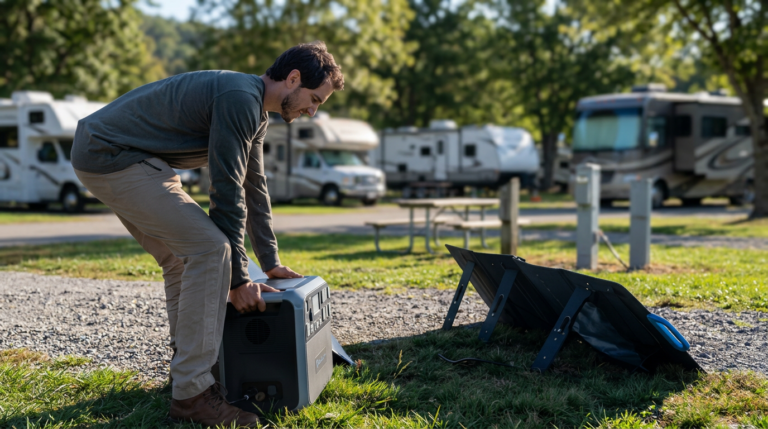
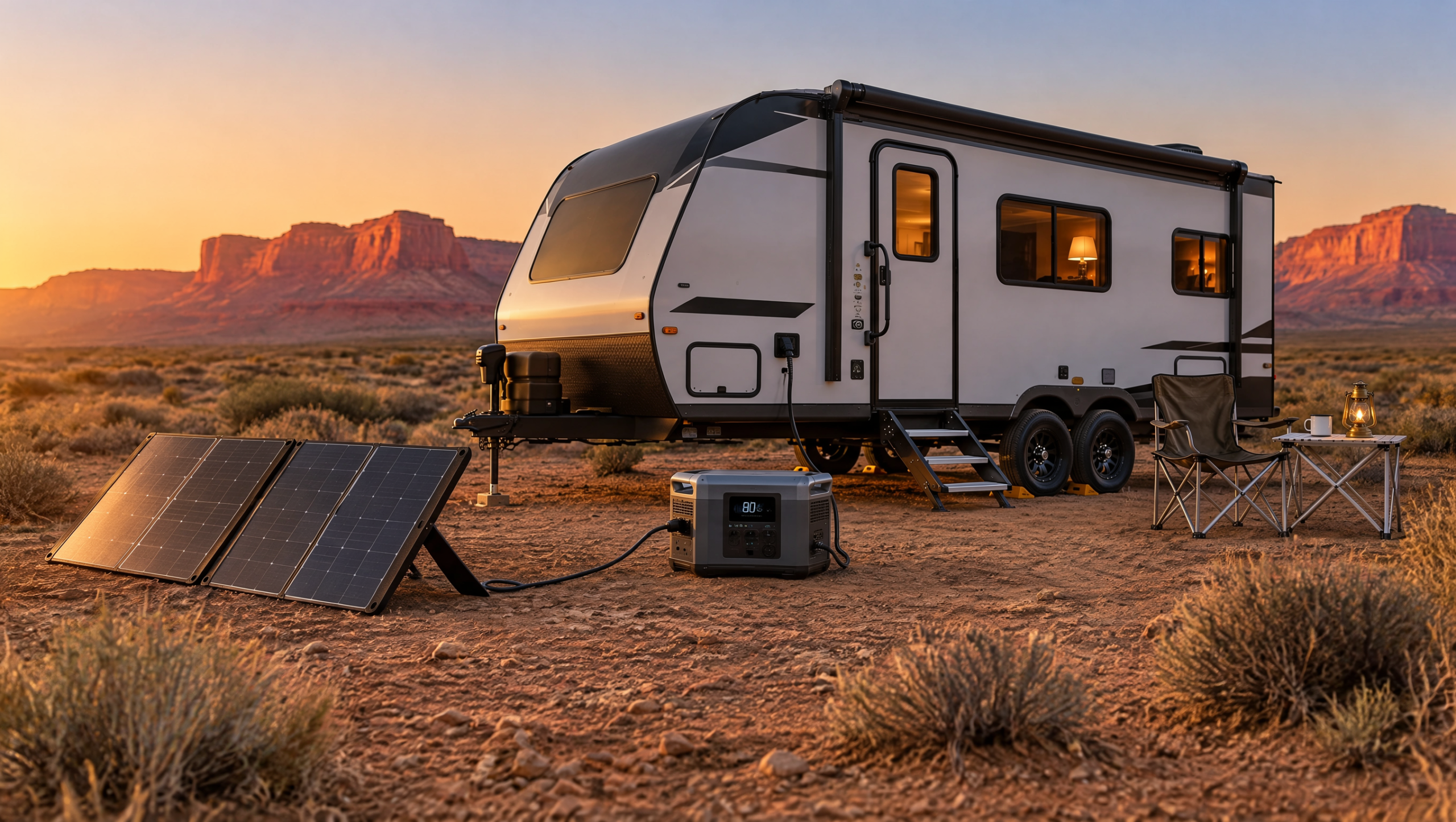
A portable power station sits outside or in a bay. You plug your shore cord into its TT-30 or 30A outlet and the RV thinks it’s on a campground pedestal. There’s no install and nothing to rewire. You can take it home for outage backup.
One catch with portables: when the RV is plugged in, its converter tries to charge the house battery from the power station. That costs you capacity. Many owners flip the converter breaker off while dry camping and let the house battery handle 12V loads.
1. Bluetti RV5 5kWh RV Kit — Best Overall Built-In System
The RV5 is a 5-in-1 hub: inverter, shore charger, solar MPPT, alternator charger and 12V DC converter. The 5kWh RV Kit pairs it with one B4810 battery (51.2V, 100Ah, 5,120Wh LiFePO4), the Epanel distribution panel and the Epad touchscreen.
- Output: 5,000W continuous AC, enough for a roof AC plus the microwave
- Battery: 5,120Wh, self-heating for cold-weather charging, IP65, rated 6,000 cycles
- Expansion: up to 24 B4810 batteries (122.88kWh)
- Certification and warranty: UL458, 5 years
- Price: kit $3,699 at Bluetti (reg. $3,999); hub alone $1,299; extra B4810 $1,699
Why it wins for dry camping: one 5kWh bank covers three days for a typical comfort camper. Alternator charging refills it while you drive to the next site. Self-heating means it still charges on a freezing morning.
Trade-offs: it’s a 48V system, so it isn’t a drop-in for a 12V bank. Most owners will want a mobile tech for the install. Some 48V appliances (like 48V air conditioners) don’t show their real-time draw on the Epad.
2. Jackery HomePower 3000 — Best Plug-and-Play for Travel Trailers
The HomePower 3000 has a 120V 30A (TT-30) outlet. Plug your 30A trailer straight into it and dry camp with no install at all. Jackery.com sells it as the HomePower 3000. Amazon and dealers list a unit with the same specs as the Explorer 3000 v2.
- Capacity: 3,072Wh LiFePO4
- Output: 3,600W continuous (7,200W surge)
- Weight: 59.5 lb
- Price: $1,499 at Jackery.com
Why it’s on the list: 3kWh covers two days for most comfort campers and three or four for minimalists. 3,600W starts a roof AC for short runs. TT-30 makes it the simplest setup here.
Trade-offs: 60 lb is a two-hand lift into a bay. Fixed capacity means no expansion battery if you outgrow it.
3. Jackery Explorer 5000 Plus — Best for Week-Long Boondocking
The 5000 Plus is Jackery’s flagship. It’s built for long stays and for doubling as home backup.
- Capacity: 5,040Wh LiFePO4, expandable to 60kWh with battery packs
- Output: 7,200W, 120V/240V
- Price: $3,499 at Jackery.com for the unit alone; sold out, with pre-orders shipping November 28
Why it’s on the list: 5kWh plus a few hundred watts of solar can stretch to a week for most couples. If you also want whole-house outage backup, it covers both jobs.
Trade-offs: at 134.5 lb it’s heavy and sized for home use. For most trailers, the HomePower 3000 is the better-sized buy.
4. Bluetti Elite 200 V2 — Best Budget Pick for Weekenders
The Elite 200 V2 is the cheapest way onto this list that still handles a coffee maker and microwave.
- Capacity: 2,073.6Wh LiFePO4
- Output: 2,600W (3,900W surge), 4 AC outlets
- Price: $899 at Bluetti
Why it’s on the list: two kWh covers a weekend minimalist with room to spare. At about $0.43 per Wh, it has the lowest cost per Wh and the lowest entry price on this list.
Trade-offs: 2,600W won’t run a roof AC for long. Full-timers will outgrow it.
5. Anker SOLIX C2000 Gen 2 — Best Lightweight Trailer Pick
The C2000 Gen 2 puts 2kWh and a TT-30 socket in a 41.7 lb box.
- Capacity: 2,048Wh LFP, expands to about 4kWh with one BP2000 Gen 2 battery (~$599)
- Output: 2,400W (4,000W peak)
- Solar input: up to 800W
- Price: $1,199.99 at Anker SOLIX (checked Nov 7, 2026); new orders ship starting November 21
Why it’s on the list: it’s the lightest unit here with a trailer plug. Start at 2kWh and add the expansion battery later.
Trade-offs: no wheels, and only one expansion battery.
6. Anker SOLIX F3800 Plus — Best for Big Rigs and Big Solar
The F3800 Plus is for Class A owners and fifth-wheels with large roof arrays.
- Capacity: 3,840Wh LFP; 7,680Wh with one expansion battery
- Output: 6,000W, 120V/240V split-phase
- Solar input: up to 3,200W through dual MPPT controllers
- RV ports: NEMA TT-30P and L14-30
- Price: sold out at Anker SOLIX as of November 7, 2026
Why it’s on the list: 3,200W of solar input is the most on this list. With a big array it can refill in a single sunny afternoon.
Trade-offs: it’s large and heavy. A small trailer doesn’t need it.
Spec Comparison
| Product | Type | Continuous AC output (W) | Expansion path |
|---|---|---|---|
| Jackery Explorer 5000 Plus | Portable | 7,200 | Battery packs to 60kWh |
| Anker SOLIX F3800 Plus | Portable | 6,000 | Expansion batteries from 7,680Wh |
| Bluetti RV5 5kWh RV Kit | Built-in | 5,000 | Up to 24 × B4810 (122.88kWh) |
| Jackery HomePower 3000 | Portable | 3,600 | None |
| Bluetti Elite 200 V2 | Portable | 2,600 | Check current Bluetti expansion options |
| Anker SOLIX C2000 Gen 2 | Portable | 2,400 | 1 BP2000 Gen 2 (~4kWh) |
Cold-Weather Dry Camping: Don’t Skip This
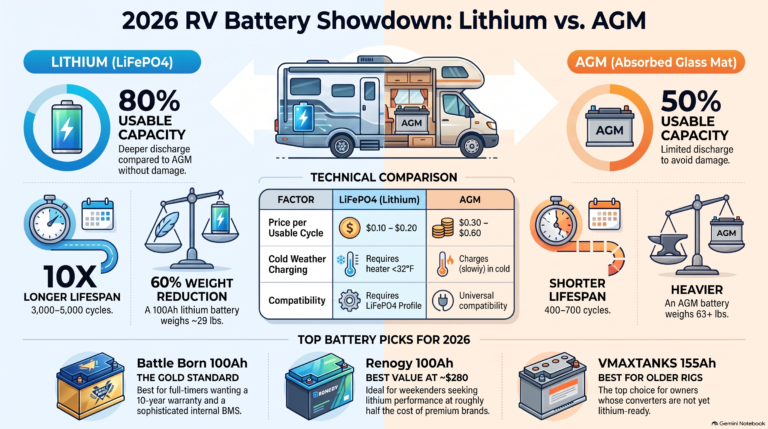
LiFePO4 batteries should not be charged below freezing (32°F). Charging cold can permanently damage the cells. Most quality units have a battery management system (BMS) that blocks charging when cold. That protects the battery, but it also means your solar does nothing on a frosty morning.
If you dry camp in shoulder season or winter, look for self-heating batteries like Bluetti’s B4810. You can also keep a portable unit inside the heated coach overnight.
Just Want to Swap Your 12V House Battery?
If you want a straight replacement for the lead-acid battery in your tongue box, a 12V 100Ah LiFePO4 drop-in is the simple route. Expect about $230–$950 per battery depending on brand and warranty.
Check two things first. Your converter needs a lithium charging profile, or it will undercharge the new battery. Your alternator may also need a DC-DC charger to charge lithium safely. Our [RV Battery Replacement guide] covers the swap step by step.
How to Choose: A 5-Step Checklist
- Add up your daily Wh with the load table above.
- Multiply by days between recharges and divide by 0.85. That is your minimum capacity.
- Check your biggest load. Continuous output must exceed it. A roof AC needs about 1,500W running plus startup surge.
- Match the hookup. Travel trailers want a TT-30 outlet. Full-timers who want one integrated bank want a built-in system.
- Plan the recharge. Count solar watts, alternator charging and generator input. Recharge speed decides how long you can stay out.
Frequently Asked Questions
How long will a 100Ah RV battery last dry camping?
A 12V 100Ah lithium battery stores about 1,280Wh. A minimalist using 700Wh a day gets almost two days. A lead-acid 100Ah battery gives about half that, because you should only use 50% of it.
Is lithium worth it for dry camping?
For most dry campers, yes. You can use 80–100% of a LiFePO4 battery’s capacity versus about 50% for lead-acid. It weighs roughly half as much and lasts thousands of cycles.
Can a power station run my RV air conditioner?
Yes, units with 3,000W or more of output can start and run a 13,500 BTU roof AC. But at about 1,400Wh per hour, a 3kWh unit gives you roughly two hours. Plan AC around solar or a generator.
Do I need solar for dry camping?
Not for a weekend if your battery is sized right. For stays over three days, solar or a generator is how you refill. Around 400W of panels covers a minimalist’s daily use in good sun.
Can I plug my RV into a portable power station?
Yes. If the unit has a TT-30 outlet, plug your 30A shore cord straight in. For 50A rigs, use an adapter or a unit with a 30A/50A RV port. Turn off the converter breaker to stop it draining the station to charge your house battery.
Should a tech install a built-in system like the Bluetti RV5?
Unless you’re comfortable with DC wiring, fusing and removing your old converter, yes. A mobile RV electrical tech can usually do it in a day. [Find an independent RV tech near you.]