Best RV Solar Kit with Battery and Inverter (2026): What to Actually Buy
A complete RV solar kit — panels, charge controller, battery, and inverter — is a $1,500–$4,000 purchase depending on system size. The kits sold as “complete” on Amazon rarely include everything: most ship panels and a controller but leave out the battery and inverter. This guide covers what’s actually in each kit, what you’ll still need to buy, and which builds make sense for which rigs.
What a Complete RV Solar System Actually Includes
- Solar panels — the power source. Sized in watts (100W, 200W, 400W, etc.).
- MPPT charge controller — regulates the panel output to safely charge your battery. MPPT is 15–30% more efficient than PWM; get MPPT for anything over 200W.
- Battery bank — stores the energy. Lithium (LiFePO4) is the right choice for any serious build (see our best RV battery guide).
- Inverter or inverter-charger — converts 12V DC battery power to 120V AC so you can run standard appliances.
- Wiring, fuses, and connectors — often sold separately or included in limited quantities.
Quick Picks
| Kit / Build | What’s Included | Best For | Est. Cost |
|---|---|---|---|
| Renogy 200W Starter Kit | 2×100W panels + 20A MPPT controller | Weekend campers, starting point | ~$280 |
| Renogy 400W Kit + 40A MPPT | 4×100W panels + 40A MPPT | Mid-size builds, add battery separately | ~$480 |
| Jackery Explorer 1000 Pro + SolarSaga 200 | Power station + panel (all-in-one) | No-install portable boondocking | ~$1,500 |
| Bluetti AC200P + PV200 | 2,000Wh station + 200W panel | Heavy users, work-from-RV | ~$1,800 |
| Component build (400W + 100Ah LiFePO4 + inverter) | Everything, sourced separately | Full permanent install | ~$1,400–$2,000 |
1. Renogy 200W Starter Kit — Best Entry Point
Who it’s for: First-time solar buyers who want a proven brand, a real MPPT controller, and a system they can expand later.
Renogy’s 200W kit ships two 100W monocrystalline panels and a 20A Wanderer MPPT controller. It does not include a battery or inverter. At ~$280, it’s the lowest-risk way to start — Renogy has years of reviews, the panels are efficient and weatherproof, and the controller is solid at this price point. Pair it with a 100Ah LiFePO4 battery (~$280) and you have a 200Ah system that covers lights, devices, and a 12V fridge with margin to spare on sunny days.
What you’ll still need: Battery, inverter (if running 120V loads), mounting hardware, wiring.
Check current price on Amazon →
2. Renogy 400W Kit + 40A MPPT — Best Mid-Size Panel Kit
Who it’s for: Campers who want enough solar to run a 12V compressor fridge, charge devices, and have headroom for an occasional AC run with batteries.
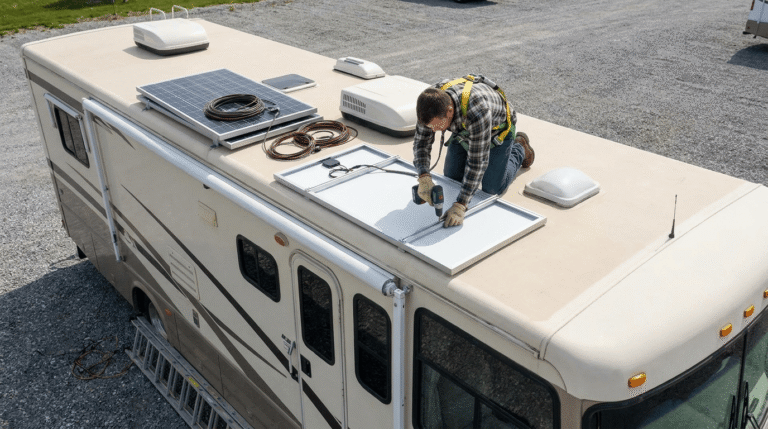
Four 100W panels plus Renogy’s 40A Rover MPPT controller. The 40A controller handles up to 520W of panels, so there’s room to add a fifth panel later. At ~$480 for the panels and controller, it’s the sweet spot for a travel trailer permanent install. Add a 200Ah LiFePO4 battery ($480–$600) and a 2,000W inverter ($300–$500) and you have a functional off-grid setup for under $1,600 total.
What you’ll still need: Battery, inverter, mounting hardware, cable entry gland, wiring.
Check current price on Amazon →
3. Jackery Explorer 1000 Pro + SolarSaga 200 — Best All-in-One Portable
Who it’s for: Campers who don’t want to wire anything, need a portable solution across multiple rigs, or rent their RV and can’t modify it.
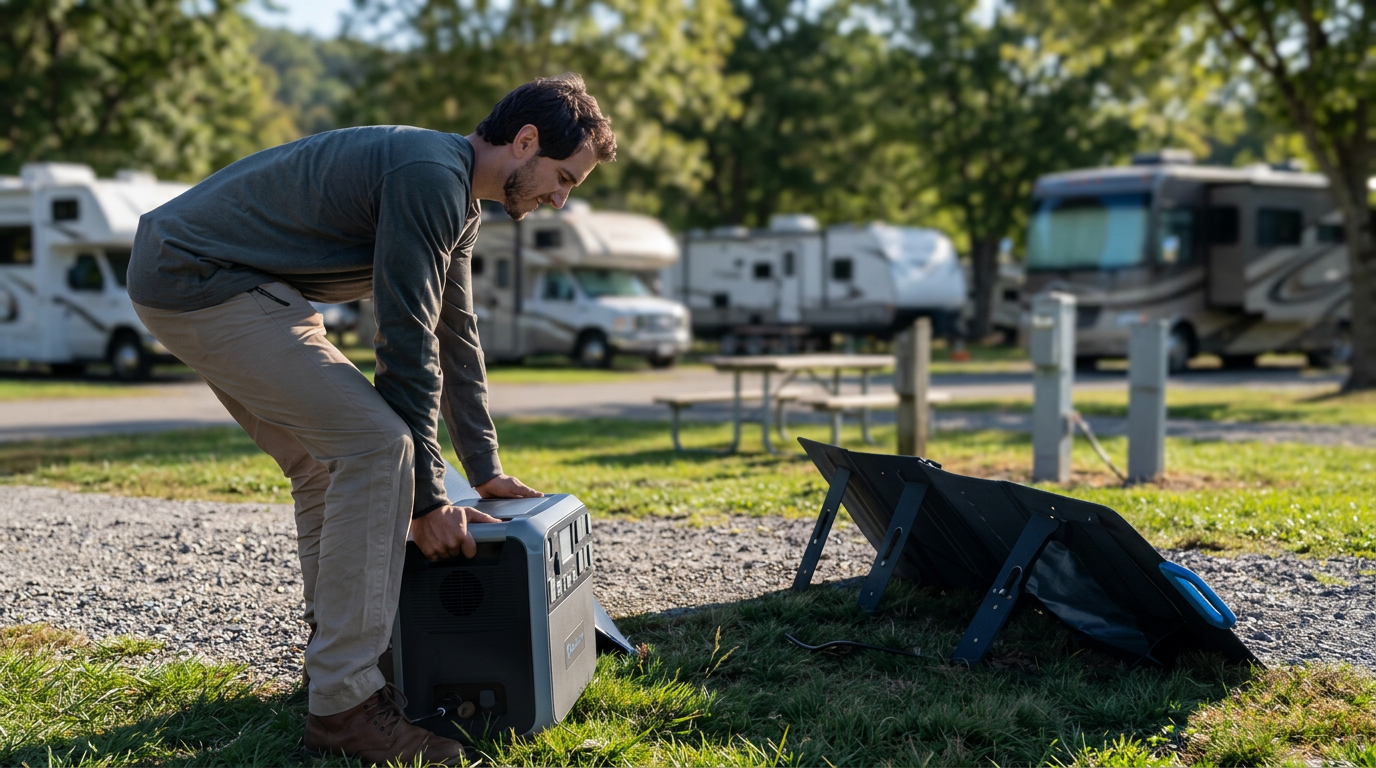
The Explorer 1000 Pro is a 1,002Wh lithium power station with a built-in inverter (1,000W continuous, 2,000W peak), charge controller, and display — everything in one unit. The SolarSaga 200 is a folding 200W panel that plugs directly into it. No roof penetrations, no wiring, no permanent installation. Set it outside when you park, charge the station, then run your devices off the AC outlets.
The tradeoff: 1,002Wh fills up in about 5 hours of sun with a 200W panel, and a 12V compressor fridge alone will drain it in 8–12 hours. This is a supplemental or short-trip system, not a full boondocking setup. But for ease of use, nothing beats it.
Key specs: 1,002Wh / 1,000W inverter / 200W panel / no installation required / 5-year warranty
Check current price on Jackery.com →
4. Bluetti AC200P + PV200 — Best for Heavy Users
Who it’s for: Full-timers, remote workers, and anyone running high-draw appliances like a CPAP, induction cooktop, or power tools off solar.
The Bluetti AC200P delivers 2,000Wh of capacity and a 2,000W pure sine inverter (4,800W peak) — double the Jackery’s capacity, with enough peak power to handle most 120V appliances. Pair it with the PV200 folding solar panel for a portable all-in-one. Add a second PV200 for 400W of charging and you can replenish the full 2,000Wh bank in about 5 hours of good sun. Expandable with additional batteries.
Key specs: 2,000Wh / 2,000W inverter / 4,800W peak / 700W max solar input / LiFePO4 cells
Check current price on BluelettiPower.com →
5. Component Build — Best Permanent Rooftop System
Who it’s for: Anyone building a permanent, hardwired system with rooftop panels, a dedicated battery compartment, and full 120V capability.
A component build costs more to plan but delivers the most capable system. The rough parts list for a solid 400W permanent setup:
- Panels: 4×100W Renogy or BougeRV rigid monocrystalline — ~$350–$450
- MPPT controller: Renogy 40A Rover or Victron SmartSolar 100/30 — ~$80–$180
- Battery: 200Ah LiFePO4 (Renogy, Ampere Time, or Battle Born) — ~$480–$650
- Inverter: Renogy 2,000W pure sine or Victron MultiPlus — ~$300–$900
- Wiring kit, cable entry, fuses: ~$100–$200
Total: $1,310–$2,380 depending on brands. If you’re comfortable with basic 12V wiring, this is a weekend DIY project. If not, budget $500–$1,000 for a shop to install it.
Frequently Asked Questions
What size solar kit do I need for full-time RV living?
At minimum: 400W of panels and 200Ah of lithium for basic boondocking (fridge, lights, devices, no AC). For comfortable full-timing with AC capability: 600–1,000W panels and 300–400Ah lithium. Add up your actual daily amp-hour draw before buying — every rig is different.
Do I need a pure sine wave inverter?
Yes if you’re running sensitive electronics (CPAP, laptop, microwave, AC unit). Modified sine wave inverters are cheaper but damage some devices over time and may not run AC motors cleanly. Buy pure sine once; don’t replace damaged equipment twice.
MPPT vs PWM charge controller — does it matter?
Yes at any panel size above 100W. MPPT controllers are 15–30% more efficient at converting panel output to usable charge, especially in non-ideal conditions (morning, late afternoon, partial shade). PWM is fine for a small trickle-charger setup; for a real system, always MPPT.
Bottom line: For a no-install portable system, the Jackery 1000 Pro + SolarSaga 200 is the easiest path. For a permanent rooftop build, the Renogy 400W kit plus a 200Ah LiFePO4 battery and a 2,000W pure sine inverter is the right component set for most travel trailers. Don’t buy a kit that skips the battery and call it complete — the battery is often 40% of the system cost and the most important decision in the build.