RV Solar Installation Cost: What to Budget in 2026
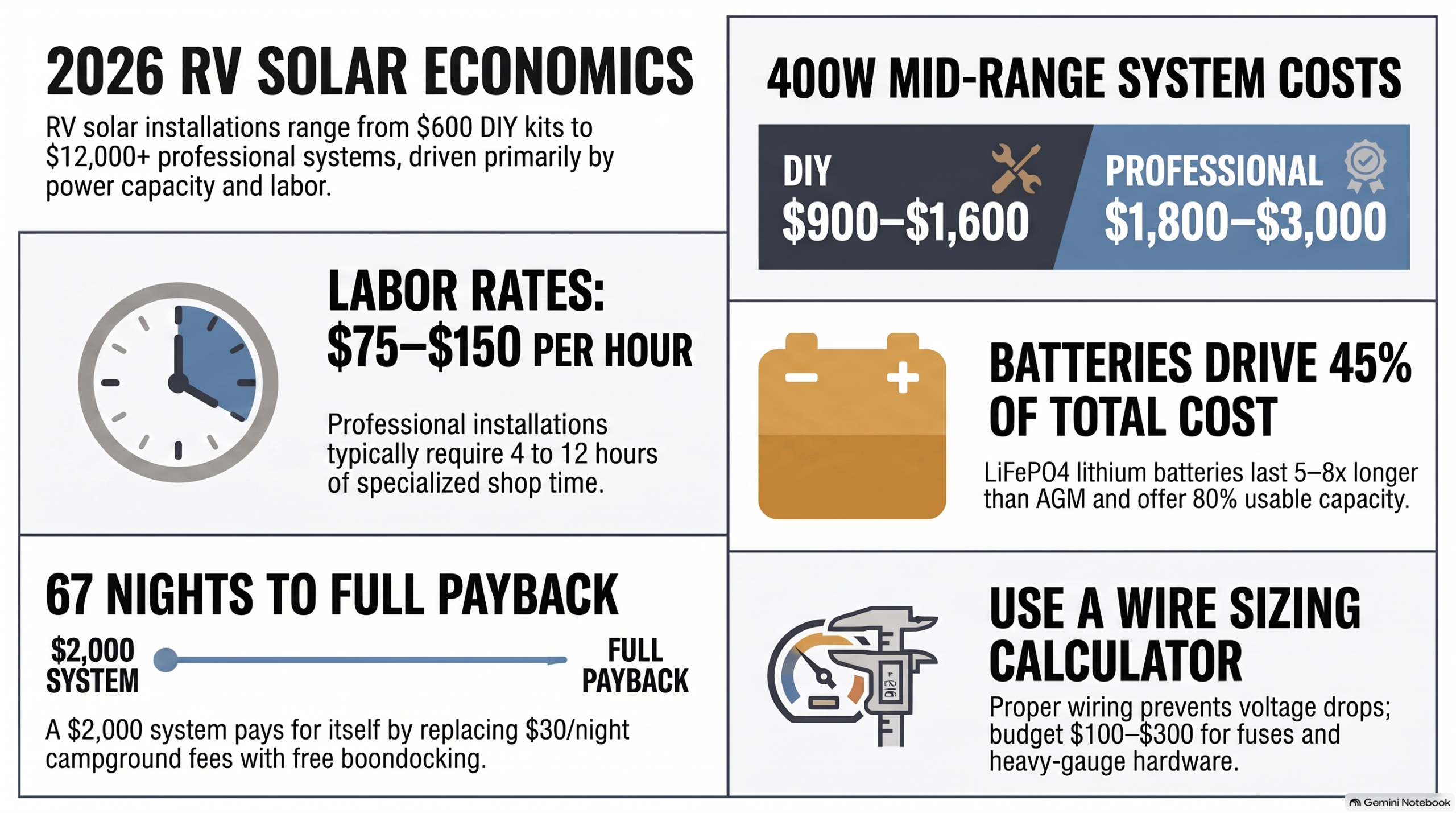
RV solar installation costs range from $600 for a basic DIY weekend setup to $8,000+ for a professional Class A build with lithium batteries, an inverter-charger, and 1,000W of rooftop panels. The variance is almost entirely explained by three factors: system size, battery chemistry, and whether you do it yourself or hire a shop. Here’s the full breakdown.
Cost by System Size
| System Size | Best For | DIY Cost | Installed Cost |
|---|---|---|---|
| 100–200W starter | Phones, lights, small fan | $300–$600 | $700–$1,200 |
| 400W mid-range | 12V fridge, devices, some 120V | $900–$1,600 | $1,800–$3,000 |
| 600–800W boondocking | Full off-grid, AC-capable | $2,000–$3,500 | $4,000–$6,500 |
| 1,000W+ full system | Full-timing, dual AC, workstation | $3,500–$6,000 | $6,500–$12,000 |
Component Cost Breakdown
Solar Panels
Monocrystalline panels run $0.70–$1.20 per watt for rigid panels from reputable brands (Renogy, BougeRV, HQST). A 400W array costs $280–$480 depending on brand and whether you catch a sale. Flexible panels cost more per watt ($1.20–$2.00) and sacrifice some efficiency; only worth it for curved roofs or van builds where rigid panels won’t fit.
Charge Controller
PWM controllers: $20–$60. Usable for systems under 200W and AGM batteries. MPPT controllers: $80–$350 depending on amperage. For any lithium battery or system over 200W, always use MPPT. The Renogy Rover 40A ($130) is the workhorse choice; the Victron SmartSolar 100/30 ($180) adds Bluetooth monitoring and better algorithm performance.
Battery Bank
This is usually 35–45% of total system cost and the biggest decision in the build. AGM deep cycle: $120–$250 per 100Ah (50% usable). LiFePO4 lithium: $250–$650 per 100Ah (80% usable). At real usable capacity, lithium costs about the same or less per usable amp-hour and lasts 5–8x longer. Budget builds use AGM; any system you plan to keep for more than 3 years should use lithium.
Inverter
Modified sine wave inverters: $40–$150. Fine for resistive loads (lights, simple chargers) but damages sensitive electronics and won’t run AC units cleanly. Pure sine wave inverters: $150–$600 for standalone units; $500–$2,000+ for combo inverter-chargers (which also replace your shore power converter). If your RV already has a good converter, a standalone 2,000W pure sine inverter ($250–$400) is the most cost-effective path.
Wiring, Fuses, and Hardware
Often underestimated. Budget $100–$300 for properly sized wire, a fused bus bar, cable entry gland (roof penetration), MC4 connectors, and mounting hardware. Going too thin on wire gauge causes voltage drop and heat — use an online wire sizing calculator for your specific run lengths and amperage.
Professional Installation Labor Costs
RV solar installation at a shop runs $75–$150 per hour. Most installations take 4–12 hours depending on system complexity. Rough labor cost ranges:
- Basic 200W starter kit (panels + controller only): $300–$600 labor
- Mid-size 400W with battery and inverter: $600–$1,200 labor
- Full 800W+ boondocking system: $1,200–$2,500 labor
Shops that specialize in RV electrical and solar work are faster and cleaner than general RV service bays. Ask specifically whether the shop has done lithium battery installs before — the charge profile differences matter and not every tech knows them.
DIY vs. Professional: Honest Assessment
| DIY | Professional | |
|---|---|---|
| Cost | Lower (save $500–$2,500) | Higher |
| Time | 1–3 weekends | 1–3 days (you drop it off) |
| Skills needed | Basic 12V wiring, roof comfort | None |
| Warranty | DIY installs rarely affect component warranties | Shop may warranty labor |
| Risk | Wiring errors, roof leaks if not sealed | Minimal if shop is reputable |
A common middle path: buy your own components (save 20–40% vs. shop markup on parts) and hire a shop for just the installation labor. Many shops will work with customer-supplied parts; some won’t — call ahead.
Frequently Asked Questions
How long does RV solar installation take?
A basic panel-and-controller install is a 4–6 hour DIY project for someone comfortable on a roof with basic electrical knowledge. A full system with battery bank, inverter, and new wiring runs 1–3 days for a DIYer or 6–12 shop hours for a professional.
Does adding solar void my RV warranty?
A properly installed solar system should not void your warranty. The Magnuson-Moss Warranty Act prohibits manufacturers from voiding warranties for aftermarket modifications unless they can prove the modification caused a specific failure. That said, sloppy wiring that causes a 12V system issue could complicate a warranty claim. Clean, properly fused installs are safe.
What’s the payback period for RV solar?
If you’re replacing $30/night campground fees with free boondocking, a $2,000 solar system pays back in about 67 nights. If you camp 30 nights a year on hookups and switch to 20 free + 10 hookup nights, payback is 5–7 years. The math improves significantly the more you camp off-grid.
Bottom line: Budget $900–$1,600 for a solid DIY 400W system that covers most weekend campers. Double it for professional installation. The biggest mistake is undersizing the battery bank to save money upfront — a 100Ah AGM bank with 400W of panels leaves you hungry by evening. Size the battery first, then match the panels to it.