7 Best RV Tire Pressure Monitoring Systems (2026)
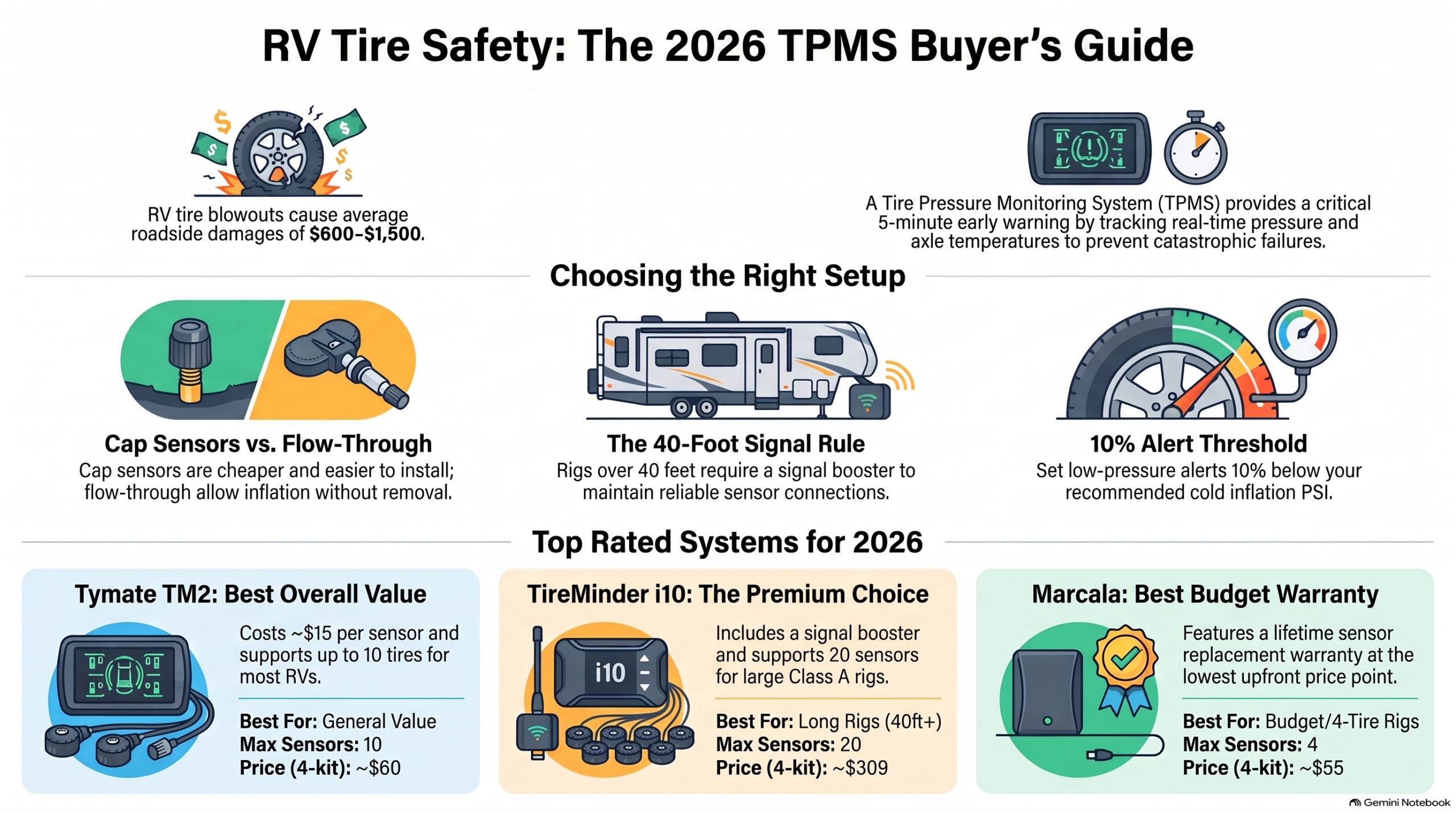
RV tire blowouts average $600–$1,200 in roadside damage — and most happen when pressure has been low for miles before the driver notices anything. A tire pressure monitoring system (TPMS) fixes that, but before you buy one there’s a fork in the road: cap sensors or flow-through sensors.
That decision shapes which systems even qualify for your rig. This review covers the 7 best RV TPMS options for 2026, with real pricing, honest tradeoffs, and a cost-per-sensor breakdown you won’t find on most roundup sites.
Quick Picks: Best RV TPMS (2026)
| Product | Price (4-sensor kit) | Sensors | Type | Display | Signal Range | Best For |
|---|---|---|---|---|---|---|
| Tymate TM2 | ~$60 | 4–10 | Cap | Solar LCD unit | 100 ft | Most RV owners — best value |
| TireMinder i10 | ~$309 | 4–20 | Cap | Color LCD + booster | 100 ft | Class A / long rigs |
| Tymate TM7 | ~$70 | 4–5 | Cap | Color LCD unit | 100 ft | Compact rigs, color display |
| Masoll M14 | ~$65 | 4–8 | Cap | Solar LCD unit | 100 ft | Budget buyers, solar monitor |
| Marcala | ~$55 | 4 | Cap | Solar LCD unit | 50 ft | Budget pick, lifetime warranty |
| Masoll M13 | ~$58 | 4–8 | Cap | Solar LCD unit | 100 ft | Set-it-and-forget-it auto-cal |
| Tymate TM3 | ~$65 | 4–10 | Cap | Solar LCD unit | 100 ft | Upgraded TM2 buyers, 2024 sensors |
Prices as of mid-2026. Verify on Amazon or manufacturer site before buying.
→ See all RV gear reviews at RV Repair Lab
Why RV Owners Need a TPMS
Passenger car tires lose pressure slowly and visibly. RV tires — especially duals on the rear axle — can be critically low while looking perfectly normal from the outside. According to NHTSA data, tire-related issues are the leading cause of roadside breakdowns for towable RVs. A blown rear dual on a Class C can cost $800–$1,500 all-in once you factor roadside assist, tire replacement, and rim damage. A $60 TPMS that gives you a 5-minute warning before a blowout is one of the better ROI purchases in RV gear. The underrated upgrade worth adding: axle temperature monitoring. Systems that track bearing temp alongside tire pressure catch wheel bearing failures before they become catastrophic — something pure TPMS units miss entirely.
→ How we evaluate RV gear costs at RV Repair Lab
Cap Sensors vs. Flow-Through: Choose This First
Cap sensors thread onto your valve stems in place of the dust cap. They’re the default on every system in this roundup — cheap, swappable in under a minute, and universally compatible. The tradeoff: they prevent you from adding air to a tire without removing the sensor first. They also add a small amount of weight to the valve stem, which matters more at highway speeds on steer axle tires.
Flow-through sensors thread between the valve stem and allow air to pass through, so you can inflate without removing anything. That convenience costs more (roughly $20–$40 extra per kit) and introduces one additional failure point — the flow-through channel can develop slow leaks if the sensor isn’t torqued correctly. For most RV owners on a budget who don’t inflate on the road, cap sensors are the right call. Flow-through makes sense if you’re frequently topping off tires at campgrounds or use a nitrogen fill service.
None of the 7 systems in this roundup are flow-through — they’re all cap-sensor based. If you specifically need flow-through compatibility, look at TireMinder’s A1A or the PressurePro systems, which are outside the scope of this review.
→ RV maintenance guides at RV Repair Lab
The 7 Best RV TPMS Systems for 2026
1. Tymate TM2 — RV Repair Lab Editor’s Choice
The Tymate TM2 is the most-purchased RV TPMS on the market for a reason: it does the job reliably at a price that doesn’t sting. For the typical 4–6 tire RV owner who just wants pressure alerts without a complicated setup, nothing else at this price tier gets out of the way as well.
Core strength for RV owners: Best value-to-reliability ratio in the category — $15 per sensor, 100-foot range, solar-powered monitor.
Key features:
- Supports 4 to 10 tires (expandable via add-on sensors)
- PSI range: 0–144 PSI — handles travel trailers through most Class C and Class A rigs
- Solar-powered LCD display unit with USB charging backup
- Real-time pressure and temperature readings per tire
- Audible and visual alerts for high pressure, low pressure, rapid deflation, and high temp
- Sensor battery: CR1632 (replaceable, ~1–2 year lifespan under normal use)
Real strengths:
- At ~$15/sensor, it’s the most cost-effective expansion path if you have a 6- or 8-tire rig — the 4-sensor kit covers a trailer, and you add sensors for the truck or toad without buying a second system.
- The solar display charges in direct sun and holds charge for 2–3 days in the shade — genuinely useful for dry camping where you don’t want another USB draw.
Honest tradeoffs:
- Not ideal if your rig is over 35 feet — the 100-foot range can drop signal on longer fifth wheels, particularly if the monitor is dash-mounted and sensors are on rear axle duals. A signal booster (sold separately, ~$25) solves this.
- The display is monochrome and functional, not color. If you want a color readout or smartphone integration, step up to the TireMinder i10.
- Tops out at 10 sensors — if you’re running a Class A with a toad (potentially 10+ tires), you’ll hit the ceiling.
Pricing: ~$60 for a 4-sensor kit; ~$14–16 per additional sensor. Cost per sensor: ~$15.
Best for: Travel trailer and Class C owners running 4–8 tires who want a proven, budget-friendly system with room to expand.
2. TireMinder i10 — Best Premium System
TireMinder is one of the few dedicated RV TPMS brands (not a car-TPMS company adapting for RVs), and the i10 is their flagship. The headline feature is the included signal booster — a separate transmitter you plug in mid-rig to bridge the signal gap on Class A coaches and long fifth wheels. Most competing systems sell that as an add-on; TireMinder bundles it.
Core strength for RV owners: Built-in signal infrastructure for long rigs — the system that solves the 40-foot problem out of the box.
Key features:
- Supports up to 20 sensors (monitors all tires simultaneously on one screen)
- PSI range: 0–199 PSI (handles high-pressure tires on Class A coaches with room to spare)
- Color LCD display with backlight
- Includes 1 RHINO signal booster/repeater
- Displays pressure and temperature simultaneously for all tires on one screen
- Transmitters are replaceable, not proprietary-locked
- 3-year warranty
Real strengths:
- The color display shows all tires at once in a layout that mirrors your rig — you don’t have to cycle through tires to see the full picture, which matters when you’re driving.
- At 20 sensor capacity, it’s the only system in this roundup that can handle a large Class A with duals plus a toad on one monitor.
Honest tradeoffs:
- Not ideal if you’re on a budget — at ~$309 for a 4-sensor kit, you’re paying ~$77/sensor. That’s over 5× the cost per sensor of the Tymate TM2 for features most 6-tire RV owners won’t fully use.
- Signal range is 100 feet in motion (same as most budget systems) — the included booster extends practical range for long rigs, but it isn’t a blanket range upgrade.
Pricing: ~$309 for 4-sensor kit; additional sensors ~$30–35 each. Cost per sensor: ~$77.
Best for: Class A motorhome and long fifth-wheel owners (35ft+) who want a purpose-built RV system with all-tires-on-one-screen display and the highest sensor capacity in this roundup.
→ View TireMinder i10 at Amazon.com
3. Tymate TM7 — Best Color Display at Budget Price
The TM7 is Tymate’s entry-level color display TPMS, sharing the same 0–144 PSI range as the TM2 but stepping up to a larger color LCD screen. It’s a more limited system in terms of sensor count — capping at 5 tires — which makes it a better fit for smaller rigs where the color display is the priority.
Core strength for RV owners: Color LCD display at a budget price point — the TM2’s upgrade path for owners who want a color readout without stepping all the way up to the TireMinder i10.
Key features:
- Supports up to 5 tires
- PSI range: 0–144 PSI
- Large color LCD display unit
- Real-time pressure and temperature per tire
- Audible and visual alerts across all alert types (low, high, rapid deflation, high temp)
- Same CR1632 sensor batteries as TM2
Real strengths:
- The color display is a genuine usability improvement over the TM2’s monochrome screen — at a glance, tire status is easier to read without squinting at small text.
- At ~$70, it’s the least expensive color-display TPMS in this roundup.
Honest tradeoffs:
- Not ideal for rigs with more than 5 tires — the 5-sensor cap excludes anything with dual rear axles or a toad. The TM2 handles up to 10 sensors.
- The PSI range is identical to the TM2 (0–144 PSI), so the ~$10 premium buys you a color screen and nothing else in terms of coverage.
- Same 100-foot range limitation as TM2 — long rigs still need an add-on booster.
Pricing: ~$70 for a 4-sensor kit; ~$16–18 per additional sensor. Cost per sensor: ~$17.50.
Best for: Single-axle travel trailer and smaller Class B or C owners who want a color display system and won’t need more than 5 sensors.
4. Masoll M14 — Best Budget Solar Option
The Masoll M14 pairs a solar-charging monitor with auto-calibration, removing two common friction points: battery management for the display and manual PSI threshold setup. For RV owners who want minimal ongoing maintenance, this combination delivers it at a mid-range price.
Core strength for RV owners: Solar-powered monitor with auto-calibration — the display charges itself, and the system sets its own pressure baselines.
Key features:
- Supports 4–8 tires
- PSI range: 0–99 PSI — suitable for most travel trailers and lighter Class C rigs
- Solar-powered monitor charges via ambient and direct light
- Auto-calibration sets baseline pressure automatically after install
- LCD display monitor
- Audible and visual alerts for all standard alert types
Real strengths:
- Auto-calibration removes a setup friction point: you install the sensors, drive 10 minutes, and the system learns your target pressures. No manual PSI entry.
- The solar monitor means one fewer USB cable in your dash setup — useful for dry camping or rigs with limited charging ports.
Honest tradeoffs:
- Not ideal if your rig has more than 8 tires — the M14 caps at 8 sensors, which excludes larger motorhomes with a toad.
- The 99 PSI ceiling is on the low side — if your tires run at 80+ PSI cold, your alert headroom gets tight. Check your tire placard before buying.
Pricing: ~$65 for a 4-sensor kit; ~$18–20 per additional sensor. Cost per sensor: ~$16.
Best for: Travel trailer owners running moderate tire pressures (under 80 PSI) who want minimal setup and a self-charging display.
5. Marcala — Best Budget Pick with Lifetime Warranty
Marcala is a newer entrant with one clear differentiator: a lifetime replacement warranty on sensors at a price that undercuts most of the competition. The extended-range version of their RV TPMS reaches 50 feet — similar to most budget systems — but the warranty removes the long-term cost uncertainty of sensor replacement that affects every other system in this roundup.
Core strength for RV owners: Lifetime sensor replacement warranty at the lowest price in the roundup — the lowest long-term cost of ownership if sensors fail.
Key features:
- 4 sensors (fixed kit; not expandable to larger tire counts)
- PSI range: 0–98 PSI (standard sensors); extended version supports 0–144 PSI
- 50-foot signal range (extended-range RV version)
- Solar-charged LCD display unit
- Lifetime sensor replacement warranty
- 6 alarm modes; IP67-rated sensors
Real strengths:
- The lifetime warranty reframes the total cost: if a sensor fails in year 3, you get a replacement at no cost. Over a 5-year ownership period, that changes the cost-per-sensor math favorably.
- At ~$55 for 4 sensors, it’s the least expensive kit in this roundup — and the warranty means you’re not gambling on sensor longevity.
Honest tradeoffs:
- Not expandable — the 4-sensor kit is a fixed system. If you need to monitor more than 4 tires (truck + trailer, or a 6-tire Class C), Marcala doesn’t scale to meet that need.
- The 50-foot signal range is standard, not exceptional. Long rigs (40ft+) may experience signal gaps.
- The 0–98 PSI ceiling may be too low for some Class C and Class A tires inflated above 80 PSI cold — verify your tire placard before buying.
Pricing: ~$55 for a 4-sensor kit; sensors are not sold individually. Cost per sensor: ~$14 (before warranty value).
Best for: Single-axle trailer owners or couples towing smaller rigs (4 tires only) who want the lowest upfront price and lifetime coverage on sensors.
6. Masoll M13 — Best Auto-Calibration
The M13 is Masoll’s auto-calibration specialist. Where most TPMS systems require you to manually enter the target PSI for each tire position — a step many owners get wrong, especially on dual rear tires at different positions — the M13 learns your pressures from a baseline drive and sets thresholds automatically.
Core strength for RV owners: Auto-calibration eliminates manual PSI entry — the setup step where most TPMS errors originate — with a solar-charging monitor to reduce cable clutter.
Key features:
- Supports 4–8 tires
- PSI range: 0–87 PSI (US version; 0–99 PSI on some listings — verify before buying if your tires run above 80 PSI)
- Auto-calibration after initial 10-minute drive cycle
- Solar-powered LCD display monitor
- Audible and visual alerts for all standard conditions
- CR1632 batteries in sensors
Real strengths:
- Manual PSI entry errors are more common than manufacturers acknowledge — owners often set alert thresholds too close to their actual running pressure, causing constant false alerts, or too far, missing real drops. Auto-calibration eliminates that variable.
- Solar monitor charging is a useful perk for dry camping or rigs with limited USB ports.
Honest tradeoffs:
- Not ideal for owners who want precise manual control over their alert thresholds — auto-calibration is convenient but less configurable than systems with manual input.
- The PSI ceiling (0–87 or 0–99 PSI) is low for heavier rigs — if your tires are inflated above 75 PSI, you may have little headroom before hitting the system’s monitoring limit.
- Same 8-tire cap as the M14, limiting larger rigs.
Pricing: ~$58 for a 4-sensor kit; ~$16–18 per additional sensor. Cost per sensor: ~$14.50.
Best for: First-time TPMS buyers with travel trailers or light Class C rigs running moderate tire pressures, who want a system that configures itself without research into PSI thresholds.
7. Tymate TM3 — Best Updated Budget Pick
The TM3 is the 2024 revision of Tymate’s platform — updated sensors with improved temperature accuracy and a refined monitor interface. If you already own an older Tymate system and need replacement sensors, the TM3 sensors are cross-compatible. As a standalone purchase it sits ~$5–10 above the TM2, with improvements that matter primarily to owners who run their rigs in temperature extremes.
Core strength for RV owners: Updated sensor generation with a color display at a budget price — the right call for RV owners in temperature extremes or existing Tymate owners needing replacement sensors.
Key features:
- Supports 4–10 tires (expandable via add-on sensors)
- PSI range: 0–144 PSI
- Updated sensor generation with color LCD display
- Solar-powered LCD display unit with USB backup
- Full alert suite: low pressure, high pressure, rapid deflation, high temp
- CR1632 batteries; compatible with TM2 monitors
Real strengths:
- Cross-compatibility with TM2 hardware means existing Tymate owners can upgrade sensors without replacing the display unit.
- The color display is a step up from the TM2’s monochrome screen, while keeping the same 10-sensor ceiling and 0–144 PSI range.
Honest tradeoffs:
- Not ideal if you’re buying from scratch and primarily care about pressure monitoring — the TM2 covers that identically at ~$5 less. The TM3 premium pays off specifically on the display quality and temperature monitoring side.
- Same 10-sensor maximum and 100-foot range as TM2; same booster limitations on long rigs.
Pricing: ~$65 for a 4-sensor kit; ~$16–18 per additional sensor. Cost per sensor: ~$16.
Best for: Existing Tymate TM2 owners upgrading sensors, and new buyers who want a color display system at the TM2 price tier.
RV TPMS Buying Guide
How Many Sensors Do You Need?
Count every tire that can fail, including your spare. Standard configurations:
- Travel trailer (single axle): 2 tires + 1 spare = 3 sensors minimum; most buyers get a 4-sensor kit and leave one spare sensor as backup
- Travel trailer (tandem axle): 4 tires + 1 spare = 5 sensors
- Fifth wheel (tandem): 4 trailer tires + 4 truck tires = 8 sensors if you monitor both
- Class A (tag axle): 6 tires standard, up to 10 with a toad
A common mistake: buying a 4-sensor kit for a tandem-axle trailer and finding you can’t add coverage for the truck or toad without a second system. Buy a system that supports your total tire count before purchasing.
→ RV buying and vetting guides at RV Repair Lab
Display Unit vs. Smartphone App
Most systems in this roundup use a dedicated LCD display unit. Here’s the honest comparison:
Display unit wins when: You’re driving and need a heads-up at a glance. An always-on dash mount shows pressure without unlocking your phone, launching an app, or dealing with Bluetooth pairing failures. When an alert fires at 65 mph, you want a beep from a dedicated unit — not a push notification you might miss.
Smartphone app wins when: You want richer historical data, per-tire charts, and alerts that reach you in the passenger seat or while you’re unhooked at a campsite. App-based systems like the TireMinder Smart TPMS (outside this roundup) log trends over time, which is useful for catching a slow leak developing across multiple trips.
For most driving situations, a dedicated display unit is more reliable. If you want both, the TireMinder i10 supports a companion app alongside its display.
→ RV gear reviews at RV Repair Lab
Signal Range and When You Need a Booster
Manufacturer signal range specs are measured in ideal open-air conditions. In a real RV — with steel frames, slide-outs, cargo, and a monitor mounted inside a cab — expect 60–70% of the stated range in practice.
Rule of thumb:
- Under 30 feet: Any 100-foot system works without a booster
- 30–40 feet: 100-foot systems may be marginal; test before relying on them
- 40+ feet: Plan to add a signal booster (~$20–35) to any standard system in this roundup
The TireMinder i10 includes a RHINO booster in the box — the only system in this roundup that does. All others require a separate purchase if your rig length puts you in booster territory. The Marcala’s 50-foot native range is not an advantage for long rigs; its value is the lifetime warranty, not signal distance.
→ RV cost data and repair guides at RV Repair Lab
Frequently Asked Questions
What PSI should I set TPMS alerts for my RV?
Never use the sidewall max PSI as your target pressure. That’s the tire’s structural limit, not the recommended running pressure. Find your recommended cold inflation PSI in your RV’s owner manual or on the tire placard (usually on the door jamb or hitch area). Set your low-pressure alert 10% below that figure. For a tire with a 65 PSI recommended cold inflation, set the low alert at 58–60 PSI. Set your high-pressure alert 10% above recommended cold inflation — tires expand under heat and load, and highway driving can add 5–10 PSI naturally.
→ RV maintenance guides at RV Repair Lab
How long do RV TPMS sensor batteries last?
CR1632 batteries in standard cap sensors typically last 12–24 months under normal use (rig driven every few weeks). Sensors that are always transmitting — on a stored rig connected to a powered monitor — can drain faster. Signs of a failing sensor battery: the monitor shows dashes instead of a reading for one tire, or a sensor disappears from the display intermittently. Replacement CR1632 cells cost $2–5 each at any hardware store. Buy a 10-pack; you’ll use them.
→ RV cost data at RV Repair Lab
Can I move my TPMS sensors to new wheels?
Yes, with one check: confirm the sensor threads match your valve stems. Most RV TPMS cap sensors use a standard 0.453-inch thread that fits TR413 and TR415 valve stems — the most common on trailer and motorhome wheels. After moving sensors to new wheels, re-pair them with the monitor following the setup sequence (typically: hold the monitor’s Learn button, then press the sensor’s reset pin in position order). The monitor reassigns sensor positions and calibrates fresh.
→ RV repair guides at RV Repair Lab
Do I need a signal booster for my RV?
If your rig is under 35 feet, almost certainly not. If you’re over 40 feet, test your system first and plan to add one. Boosters work by capturing the sensor signal mid-rig and re-broadcasting it to the monitor — most plug into a standard outlet and install in under 5 minutes. Cost is typically $20–35 for a compatible booster. The TireMinder i10 (includes a booster in the box) is the only system in this roundup that solves the long-rig signal problem without a separate purchase. Every other system, including the Marcala (50-foot native range), requires a separately purchased booster for rigs over 40 feet.
→ View RV gear reviews at RV Repair Lab
Prices and availability verified mid-2026.