AGM vs Lithium RV Battery: Which Is Actually Worth It?
AGM or lithium? It’s the most common battery question in the RV world — and the answer has changed dramatically over the last three years. Lithium used to cost 4x as much as AGM; now the gap has narrowed to the point where the math strongly favors lithium for most buyers. Here’s how they actually compare and when each one makes sense.
Head-to-Head Comparison
| Factor | AGM | Lithium (LiFePO4) |
|---|---|---|
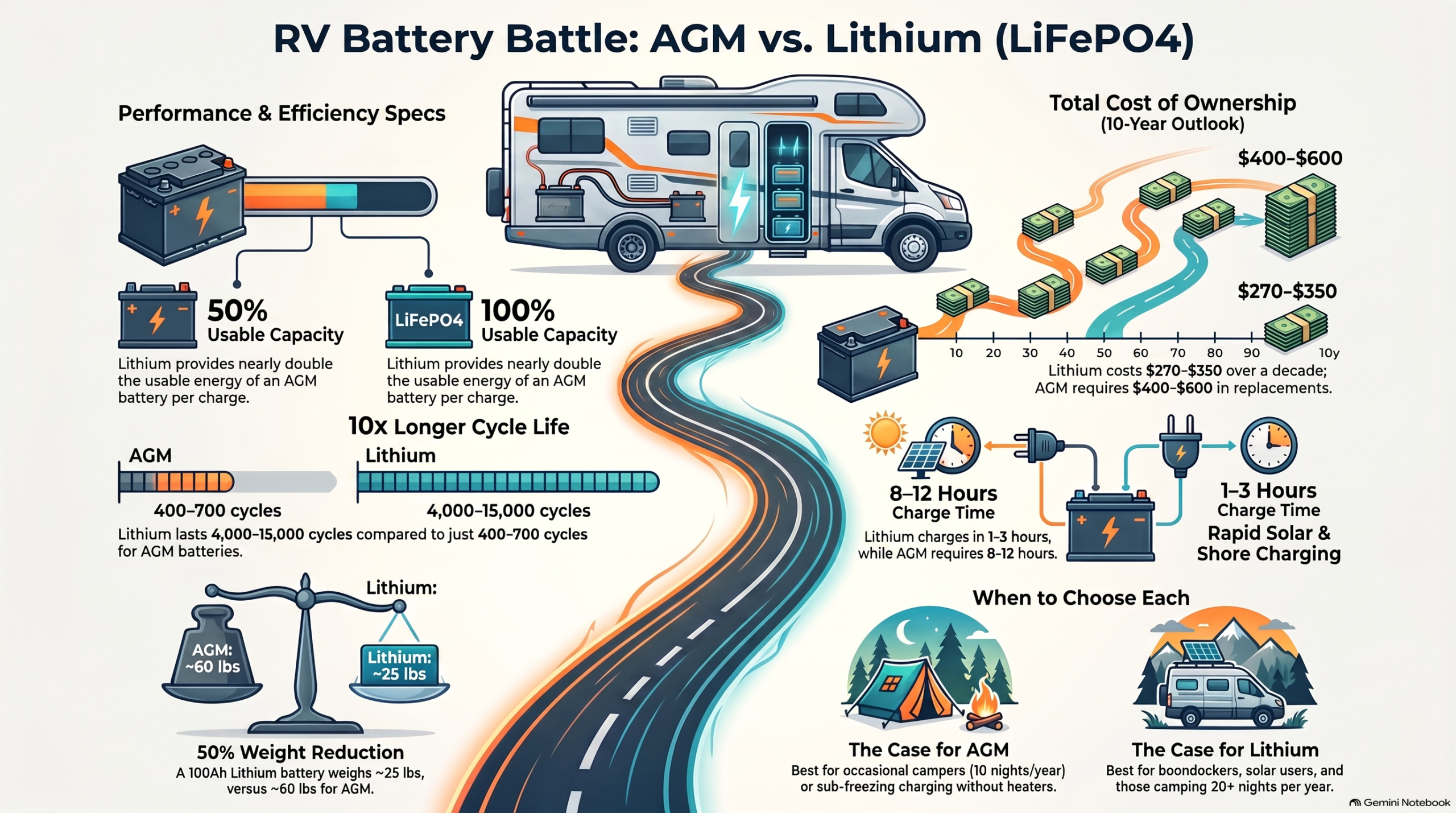
| Usable capacity | 50% of rated Ah | 95–100% of rated Ah |
| Cycle life | 400–700 cycles | 4,000–15,000 cycles |
| Lifespan | 3–5 years | 10–15 years |
| Weight (100Ah) | 55–65 lb | 22–29 lb |
| Charge time (100Ah) | 8–12 hours | 1–3 hours |
| Self-discharge per month | 3–5% | 1–3% |
| Cold-weather charging | Reduced but works | Not below 32°F (without heater) |
| Upfront cost (100Ah) | $150–$250 | $270–$350 |
| Cost per usable Ah | $3.00–$5.00 | $2.80–$3.50 |
| Maintenance | None (sealed) | None |
| Charger compatibility | Any 12V charger | Needs 14.4V profile, no equalization |
The Real Cost of Each Battery
Looking at purchase price alone misses the story. Let’s compare the true 10-year cost of a 100Ah bank:
AGM: A quality 100Ah AGM battery costs $200 and lasts about 500 cycles (3–4 years with regular use). You’ll replace it 2–3 times over 10 years. Total cost: $400–$600 in batteries alone, plus the labor and hassle of each replacement.
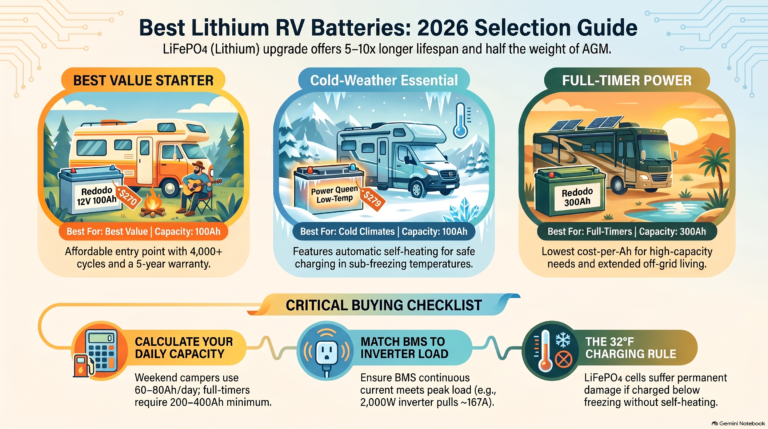
Lithium: A quality 100Ah LiFePO4 battery costs $270–$350 and lasts 4,000+ cycles — a decade or more of regular use. You buy it once. Total cost: $270–$350.
Lithium costs less over 10 years, and that’s before accounting for the usable capacity difference. A 100Ah AGM gives you about 50Ah of usable energy; a 100Ah lithium gives you 95Ah. To get the same usable capacity from AGM, you need a 200Ah AGM battery — which costs $350–$500 and still won’t last as long.
Where AGM Still Has the Edge
Cold-Weather Charging
AGM batteries can be charged in sub-freezing temperatures without damage — charging slows down, but it works. LiFePO4 batteries must not be charged below 32°F without a built-in heater or external heating pad, or you risk lithium plating that permanently degrades cell capacity. If you camp in cold climates frequently and don’t want to deal with a heated battery or temperature management, AGM is simpler.
Upfront Cost Sensitivity
If you’re on a very tight budget and only camp occasionally, an AGM battery gets the job done for $150–$200 with no charger adjustments needed. If you use your RV 5–10 nights a year, the math on lithium’s long-term savings gets thinner. For light seasonal use, AGM is a defensible choice.
Charger Compatibility
AGM works with virtually any 12V battery charger and converter. Lithium requires a charger that can deliver 14.4V absorption without automatic equalization cycles. Most modern converters support this, but older rigs may need a converter upgrade — adding $150–$400 to the conversion cost.
Where Lithium Clearly Wins
Weight
A 100Ah AGM weighs 55–65 lb. A 100Ah LiFePO4 weighs 22–29 lb. For a two-battery bank, that’s 60–80 lb of weight savings — meaningful for fuel economy, weight distribution, and ease of installation. For van builds and smaller trailers with tight payload limits, lithium is often the only practical choice.
Charging Speed
AGM batteries charge efficiently up to about 20% of their capacity in amps — so a 100Ah AGM charges at 20A maximum before it starts tapering off. A lithium battery accepts up to 50–100% of its capacity in amps, meaning a 100Ah LiFePO4 can take 50–100A without heat or damage. Faster charging means more usable energy from limited solar or generator runtime.
Consistent Voltage Under Load
AGM voltage sags significantly under load, especially below 50% state of charge. This causes LED lights to dim, inverters to work harder, and some devices to behave erratically. Lithium maintains a nearly flat discharge curve — a lithium battery at 30% SOC delivers almost the same voltage as one at 80%, meaning appliances behave consistently all the way to cutoff.
Solar Compatibility
Lithium’s high charge acceptance rate pairs perfectly with solar. When panels are producing, lithium soaks up every amp quickly and efficiently. AGM’s slow acceptance rate means solar panels often sit in absorption or float mode long before the battery is truly full — wasting available solar harvest.
Our Recommendation
Choose lithium if: you camp more than 20 nights a year, you boondock or use solar, you have a weight-sensitive rig, or you want to buy once and stop thinking about batteries.
Choose AGM if: you camp occasionally (fewer than 10 nights a year), you’re on a very tight upfront budget, or you camp exclusively in sub-freezing temperatures without a heated battery option.
For lithium, the Redodo 12V 100Ah (~$270) and the Power Queen 100Ah Group 24 are the best-value starting points. For cold-weather use specifically, the Power Queen Low-Temp Smart adds self-heating that eliminates the main downside of lithium in winter.
FAQ
Is lithium worth it for an older RV?
Usually yes, as long as your converter can be set to a lithium charging profile. The battery swap is straightforward regardless of rig age — the wiring is the same. The only complication is if you have a very old single-stage converter that can’t be adjusted, in which case add a $150–$250 converter upgrade to the budget.
Can AGM and lithium batteries be charged by the same solar controller?
Yes — separately. A good MPPT solar controller (like the Victron SmartSolar or Renogy Rover) has selectable battery profiles. Switch it to LiFePO4 mode when you convert and it handles the rest. You can’t charge a mixed AGM/lithium bank simultaneously, but if you’re running all lithium the controller just needs a profile change.
Do AGM batteries require maintenance?
Sealed AGM batteries require no maintenance — no watering, no equalization (though some chargers do an optional equalization cycle). Standard flooded lead-acid batteries require monthly watering to top up the electrolyte. AGM is the lower-maintenance of the two lead-acid options, but still falls short of lithium’s zero-maintenance profile.
Bottom line: The cost math now favors lithium for most RV buyers. Buy an AGM battery today and you’ll likely spend more replacing it twice over the next decade than you would have spent on a lithium battery that never needs replacing. See our full best lithium RV battery guide for the top picks at every capacity.