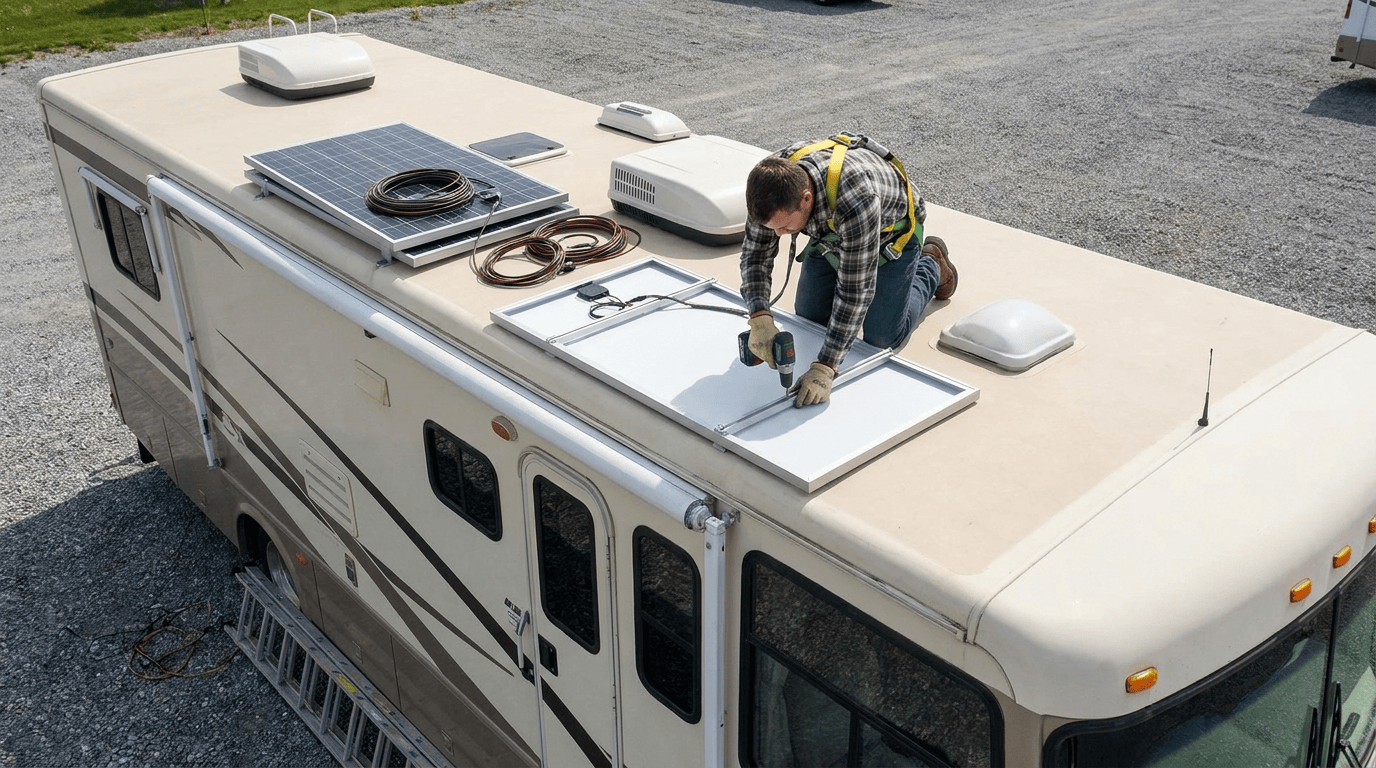
Best Motorhome Solar Kit (2026): Class A, B, and C Builds Compared
3 rig classes covered | 5 build approaches compared | Integrated vs component vs portable
Motorhome solar is one of the most misunderstood upgrades in RV ownership. Some owners spend $8,000 piecing together components that don’t quite work together. Others buy a $500 kit that can’t power what they actually need. And most of the “best RV solar kit” content on the internet is thin affiliate content that recommends whatever product has the highest commission — not what actually works for your specific rig.
The reality: the right motorhome solar setup depends on your rig class, your usage pattern, and how much you want to deal with system integration. A Class A owner doing extended boondocking has completely different needs than a Class B owner running weekend trips. And the “kit” that’s perfect for one is wildly wrong for the other.
This guide walks through the best motorhome solar kits for 2026 — organized by Class A, B, and C — with honest picks across integrated all-in-one systems, component builds, and portable options. Real specs, real prices, and clear reasoning about which system fits which rig.
First: The Three Categories of Motorhome Solar
Not all solar setups are structured the same way. Understanding the categories is critical before picking a kit.
1. All-in-one integrated systems
A single manufacturer builds and pre-configures the inverter, battery, solar charge controller, alternator charger, DC distribution, and protection into one platform. Install is faster (hours instead of days), reliability is higher (fewer mismatched components), and the whole system is designed to work together from the factory.
Downside: you’re locked into the manufacturer’s ecosystem. Upgrades and replacements come from them.
2. Component-based builds
Traditional approach: buy panels, charge controller, inverter, batteries, wiring, and mounting hardware from various manufacturers. Assemble it yourself or have an installer do it. Maximum flexibility and can be cheaper for smaller systems.
Downside: significant assembly labor, potential compatibility issues, more failure points, longer install time (days to a week).
3. Portable power stations
Standalone units (Bluetti, Jackery, EcoFlow, Anker Solix) that plug into your RV’s outlets or wire directly. Not really “kits” in the traditional sense but increasingly used as motorhome power solutions, especially in smaller rigs.
Downside: capacity limits, requires manual solar panel deployment, less integration with rig systems.
Which category is right depends on your rig class and priorities. Class A owners with limited DIY interest gravitate toward all-in-one. Component builds appeal to DIYers who want customization. Portables work well for Class B or as supplemental power.
Class A Motorhomes: The Big-Power Category
Class A rigs need serious power. Multiple ACs, residential fridges, entertainment systems, and everything else that comes with 30-40 feet of luxury coach. Your solar kit needs to match that reality.
Realistic power needs:
- Continuous inverter output: 3,000W minimum, 5,000W preferred
- Battery capacity: 5-10 kWh minimum, 10-20 kWh for full-time boondocking
- Solar array: 600-1,600W depending on climate and usage
- Charging capacity: alternator + solar + shore power all functional
Best All-in-One for Class A: Bluetti RV5 / RVSolar System
The Bluetti RV5 is one of the strongest all-in-one motorhome solar solutions on the market for 2026. It replaces the piecemeal approach with one integrated platform — inverter, charge controller, alternator charger, DC distribution, and protection built into a single unit.
Key specs:
- 5,000W continuous / 10,000W surge inverter — runs A/C, fridge, water pump, and electronics simultaneously
- 5.12 kWh LiFePO4 battery (expandable to 122 kWh with additional batteries)
- 1,620W DC output for 12V systems
- Charges via solar, alternator, shore power, generator, or EV charger
- 80% charge in 50 minutes on shore power
- IP65-rated battery for RV road conditions
- Under 50dB operating noise — genuinely quiet when parked
- Touchscreen and mobile app control
- Vibration-resistant construction
Available configurations:
- RV5 Power Hub alone: $1,499 (BYO batteries)
- 5kWh Power Kit: $3,299 (hub + 1 battery, van-conversion focused)
- 5kWh RV Kit: $3,999 (hub + battery + control panel + tablet — the standard package)
- 10kWh RV Kit: $5,999 (best seller — full Class A boondocking setup)
- 5kWh RV Kit + 200W solar panel: $4,399
- 5kWh RV Kit + 400W solar (2x200W): $4,699
- 5kWh RV Kit + 600W solar (3x200W): $4,999
Why it works for Class A:
Most Class A solar installations are $6,000-$12,000 component builds involving 3-5 days of labor. The RV5 10kWh RV Kit at $5,999 delivers comparable output — 5kW inverter, 10kWh of LiFePO4, integrated charging from multiple sources — in a single package that installs in a few hours instead of days.
For Class A owners who don’t want to become their own solar electrician (or who don’t want to pay $2,000-$4,000 in installation labor for a component build), the integrated approach usually wins on total cost and reliability.
The 5kW continuous output is what makes this fit Class A specifically. Many “RV solar kits” cap at 2,000-3,000W, which won’t run a rooftop AC alongside other loads. The RV5’s 5,000W handles it.
Best for: Class A owners wanting integrated boondocking capability, first-time solar buyers, owners frustrated with the complexity of piecing together component systems.
Consider alternatives if: You want completely custom capacity (RV5 tops out at 122 kWh but locks you into Bluetti’s battery ecosystem), you already have a preferred inverter brand, or you’re doing a highly-customized off-grid van build.
Best Component Build for Class A: Renogy 1600W Solar Kit + Battle Born Lithium
For DIYers who want maximum customization, the component approach still has merit — especially for Class A owners with unusual roof layouts, dual-alternator setups, or specific brand preferences.
Typical Class A component build:
- Solar panels: 4-8x Renogy 200W monocrystalline ($1,000-$2,000 total)
- Charge controller: Renogy Rover 100A MPPT or Victron SmartSolar 250/100 ($300-$700)
- Inverter/charger: Victron MultiPlus 3000W or 5000W ($1,800-$3,500)
- Battery bank: Battle Born 100Ah 12V LiFePO4 (4x for 5 kWh) or 200Ah units ($3,000-$5,000)
- DC-DC alternator charger: Victron Orion-Tr Smart or Renogy 60A DCC ($300-$600)
- Wiring, mounting, breakers, and fuses: $500-$1,000
- Installation labor (if outsourced): $1,500-$4,000
Total component cost: $8,000-$16,000 depending on capacity and brand choices.
When component builds win:
- Custom capacity requirements
- Existing partial system to build onto
- Specific brand preferences (Victron ecosystem loyalty is real)
- Willingness to invest 3-5 days of DIY labor
- Redundancy across multiple manufacturers desired
When they lose:
- First-time solar builders
- Owners without wiring/electrical experience
- Anyone who values plug-and-play over customization
- Rigs where install labor cost approaches component cost
Check Renogy prices on Amazon.com
Class B Camper Vans: The Space-Constrained Category
Class B vans have completely different constraints than Class A. Limited roof area, limited interior space for equipment, and typically lower power needs (no residential fridge, often no rooftop AC, smaller battery banks).
Realistic power needs for Class B:
- Continuous inverter output: 1,000-3,000W depending on usage
- Battery capacity: 2-5 kWh
- Solar array: 200-500W (roof space limits)
- Emphasis on integration with van chassis systems
Best All-in-One for Class B: Bluetti RV5 5kWh Power Kit
Get the Bluetti RV5 5kWh Power Kit →
The 5kWh Power Kit variant of the RV5 ($3,299) is specifically designed for van conversions and custom builds. Same 5,000W inverter and 5.12 kWh battery as the full RV kit, but stripped of the control panel and tablet — components that many custom van builders replace with their own preferred controllers.
Why it fits Class B:
- 5,000W is overkill for most van conversions but future-proofs the build if the owner later adds a mini-split AC or induction cooktop
- 5.12 kWh capacity handles typical van usage — LED lights, water pump, fridge, laptop charging, occasional inverter loads — for 2-4 days without solar input
- Compact form factor fits under a bench seat or in a rear storage area
- Vibration-resistant construction handles off-road use better than component systems
- Alternator charging (up to 100A) means driving replenishes the battery bank
- Roof solar can be added incrementally (200W-600W panel options)
Class B specific advantages over component builds:
Van conversion component systems typically cost $4,000-$8,000 in parts alone, plus 3-5 days of build time. The RV5 5kWh Power Kit at $3,299 installs in hours and delivers equivalent performance.
Best for: Van conversion projects, Class B factory rigs looking to upgrade solar, off-grid van dwellers wanting simplicity.
Consider alternatives if: You have limited under-bench storage space (the RV5 hub + battery combo needs about 2-3 cubic feet), or you’re doing a minimalist van build where 3-5 kWh is more than you need.
Best Budget Class B Solution: Renogy 400W Van Kit
For Class B owners with modest power needs, Renogy’s 400W solar kit paired with a 2,000W inverter and 200Ah lithium battery bank runs $2,000-$3,000 in components. Fewer features than the RV5 (no integrated alternator charger, no touchscreen monitoring, more assembly required) but capable for basic van power needs.
Class C Motorhomes: The Middle Ground
Class C rigs sit between Class A and Class B in every dimension — power needs, roof space, complexity, budget. The good news: you have the widest range of viable options.
Realistic power needs for Class C:
- Continuous inverter output: 2,000-4,000W
- Battery capacity: 3-8 kWh
- Solar array: 400-800W
- Balance between integration and cost
Best All-in-One for Class C: Bluetti RV5 5kWh RV Kit
Get the Bluetti RV5 5kWh RV Kit →
The standard 5kWh RV Kit ($3,999) hits the Class C sweet spot. Full monitoring panel and tablet, 5kW inverter, 5.12 kWh battery, and complete wiring packages included.
Why it works for Class C:
- Handles the most common Class C loads: rooftop AC + fridge + electronics simultaneously
- 5.12 kWh capacity supports 2-3 days of boondocking with typical Class C usage
- Alternator charging integrates with the chassis without additional components
- Expandable to 10 kWh by adding a second B4810 battery ($1,999) if usage grows
- Complete monitoring via the included Epad tablet
- Optional solar packages ($400-$1,000 extra for 200W-600W panels)
The 5kWh RV Kit + 400W solar package ($4,699) is arguably the best all-in-one motorhome solar solution for Class C boondocking on the 2026 market. Full integration, real capacity, real solar input, one manufacturer, one warranty, real installation timeline (hours, not days).
Best for: Class C owners doing occasional to regular boondocking, snowbirds who want backup power away from shore power, anyone tired of hearing generators.
Best Mid-Range Component Build for Class C: Renogy 800W Kit + Lithium
For Class C owners preferring the component approach: Renogy 800W solar kit ($1,400) + Renogy 3000W pure sine inverter ($800) + 400Ah of Battle Born or Renogy lithium ($2,400-$3,600) + wiring and mounting ($500).
Total: $5,100-$6,300 in parts, plus $1,000-$2,500 in labor if outsourced.
Comparable to the RV5 5kWh RV Kit + 400W in output, but with 3-5 days of assembly and more complexity.
Comparison Table: Best Motorhome Solar Kits 2026
| Kit | Rig Class | Inverter | Battery | Solar Included | Approx Price |
|---|---|---|---|---|---|
| Bluetti RV5 Power Hub | All classes (BYO battery) | 5,000W / 10,000W surge | — | — | $1,499 |
| Bluetti RV5 5kWh Power Kit | Class B / Van conversion | 5,000W / 10,000W surge | 5.12 kWh LiFePO4 | Optional | $3,299 |
| Bluetti RV5 5kWh RV Kit | Class C / Class A entry | 5,000W / 10,000W surge | 5.12 kWh LiFePO4 | Optional | $3,999 |
| Bluetti RV5 10kWh RV Kit | Class A / Full-timer | 5,000W / 10,000W surge | 10.24 kWh LiFePO4 | Optional | $5,999 |
| Bluetti RV5 5kWh + 400W Solar | Class C boondocker | 5,000W / 10,000W surge | 5.12 kWh LiFePO4 | 400W included | $4,699 |
| Renogy 400W Van Kit | Class B | 2,000W (separate) | 200Ah (separate) | 400W included | $2,000-$3,000 |
| Renogy 800W Component Kit | Class C DIY | 3,000W (separate) | 400Ah (separate) | 800W included | $5,100-$6,300 |
| Component Custom Build | Class A DIY | 3,000-5,000W | 5-10 kWh | 600-1,600W | $8,000-$16,000+ |
Buying Guide: What Actually Matters
If you’re evaluating solar kits, here’s what to weigh — in order of importance for most motorhome buyers:
1. Continuous inverter output. Match to your loads. Rooftop AC needs 1,500-2,500W continuous. Add fridge, water pump, electronics, and residential fridge (if equipped) — total continuous load determines minimum inverter size. Undersized inverters trip on startup surges from AC units.
2. Battery capacity. Determines how long you can run without solar input. Rough guide: 5 kWh for 2 days typical use, 10 kWh for 3-4 days, 15 kWh+ for full-timer boondocking.
3. Charging inputs. The system should accept solar, alternator (for driving), and shore power simultaneously. Bonus: generator input and EV charger capability. Integrated systems handle all of these; component systems require separate charge controllers for each input.
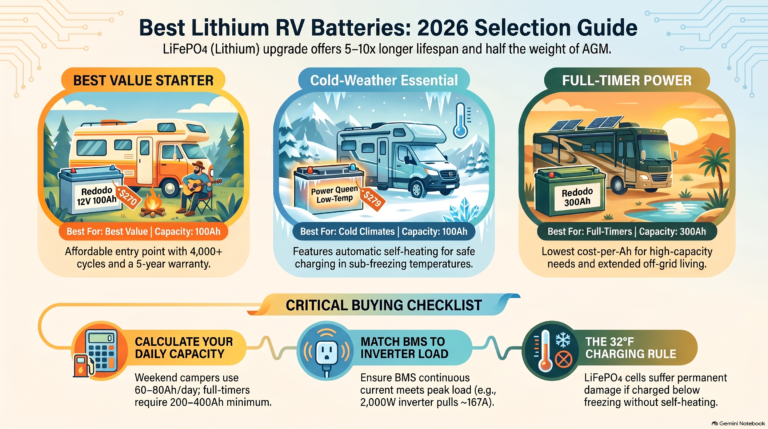
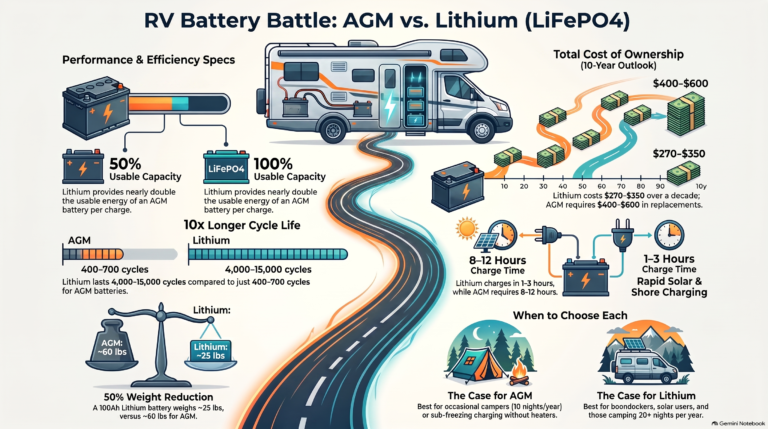
4. Battery chemistry. LiFePO4 is the current standard — longer lifespan (10-15 years), deeper discharge (down to 20% safely), lighter weight, and no maintenance vs lead-acid. Don’t buy lead-acid for new installs.
5. Ease of installation. All-in-one systems install in hours. Component builds take days and require electrical knowledge. Factor labor cost if outsourcing — a $6,000 component build with $2,500 in labor total is $8,500, often more than an integrated system.
6. Warranty and support. Bluetti offers global warranty and lifetime support on the RV5. Renogy warranties are competitive but shorter on some products. Individual component warranties vary by brand.
7. Expandability. Do you plan to grow the system? The RV5 scales from 5 kWh to 122 kWh by adding batteries. Component builds are flexible but require rewiring for major expansions.
8. Physical size and weight. Solar equipment takes real space and weight. Class B builds particularly constrained. Weigh dimensions vs available bay/storage space before buying.
9. Solar panel included vs separate purchase. All-in-one kits often bundle panels; component approaches require separate panel selection. Included panels are usually adequate but not always the best rated for your specific climate.
10. Monitoring and control. Real-time visibility into battery status, charging inputs, and load makes troubleshooting dramatically easier. Integrated systems have this built in. Component systems require separate monitors (Victron Cerbo GX, Renogy DC Home, etc.).
The Real Cost Comparison
For a fair comparison across approaches, here’s realistic total cost including installation for a typical Class C boondocking setup:
Bluetti RV5 5kWh RV Kit + 400W Solar:
- Equipment: $4,699
- Installation (DIY): $0 in labor
- Installation (professional): $500-$1,000
- Total: $4,699-$5,699
Comparable component build:
- Solar panels (400W): $600-$1,000
- MPPT charge controller: $250-$500
- 3,000W inverter/charger: $1,200-$1,800
- 400Ah LiFePO4 battery bank: $2,400-$3,600
- DC-DC alternator charger: $300-$500
- Wiring, breakers, mounting: $400-$700
- Installation labor: $1,500-$3,000
- Total: $6,650-$11,100
Component builds have flexibility advantages, but for equivalent output, the integrated approach usually wins on total cost — sometimes by thousands.
Frequently Asked Questions
How much solar power does a motorhome need?
Depends on usage. Weekend camping: 200-400W of solar and 2-3 kWh battery. Regular boondocking: 400-600W solar and 5-8 kWh battery. Full-time off-grid: 600-1,200W solar and 10-15 kWh battery. Class A rigs typically need double what Class B needs.
Can I run my rooftop AC on solar?
Yes, with adequate inverter and battery capacity. You need at least 2,000W continuous inverter output (2,500W preferred), plus enough battery capacity to run the AC for several hours between recharges. The Bluetti RV5 handles rooftop AC on any Class A, B, or C rig. Component systems need matching capacity.
What’s the difference between an all-in-one system and a component build?
All-in-one systems (like Bluetti RV5) integrate the inverter, charger, solar controller, and protection into a single platform from one manufacturer. Component builds combine individual products from various manufacturers. All-in-one is faster to install and more reliable; component builds offer more customization at higher labor cost.
How long do RV solar batteries last?
LiFePO4 lithium batteries last 10-15 years with 2,000-5,000 charge cycles depending on usage patterns and quality. Lead-acid batteries typically last 3-5 years. Newer lithium chemistry vastly outperforms lead-acid for motorhome applications.
Do I need a solar controller?
Yes, for any solar setup. The controller regulates power from panels to prevent overcharging batteries. Integrated systems include this. Component builds require an MPPT (Maximum Power Point Tracking) charge controller matched to your solar array’s voltage and current.
How much does professional installation cost?
$500-$1,000 for an integrated system like the Bluetti RV5. $1,500-$4,000 for a full component build depending on complexity and rig type. Class A installations run higher due to complexity.
Should I add solar to my existing RV or upgrade the whole system?
Depends on your current system. If you have basic lead-acid batteries and no solar, upgrading to an integrated LiFePO4 system delivers 2-3x the capacity and dramatically better performance. If you have adequate lithium already, adding solar to it is straightforward.
What about portable solar generators like Bluetti Elite or Jackery?
Portable units work well as supplemental power or for small rigs. They’re generally not sized for full motorhome integration (limited inverter output, no alternator charging, manual panel deployment). For serious motorhome solar, an installed integrated system like the RV5 or a component build is the right approach.
How long does it take to install an integrated RV solar system?
The Bluetti RV5 typically installs in 4-8 hours for a DIYer, or half a day for a professional. Component builds run 3-7 days depending on rig complexity.
Can I use my existing chassis batteries with a solar upgrade?
Yes, but usually not recommended. Chassis (starter) batteries and house (deep-cycle) batteries serve different purposes. Modern solar upgrades typically add dedicated house batteries (integrated in the RV5 or separate lithium bank) while leaving chassis batteries alone.
Do I need permits or inspections for RV solar installation?
Federal law doesn’t require permits. Some states or campgrounds have restrictions on visible panels. RV insurance may require notification of significant electrical modifications. Check your specific state and insurance policy.
How much do solar panels cost per watt in 2026?
Rigid mono panels: $1-$2 per watt retail. Flexible panels: $2-$4 per watt. Prices continue declining as panel technology improves. Total system cost is dominated by inverter and battery, not panels.
Bottom line: For most motorhome owners in 2026, an all-in-one integrated system like the Bluetti RV5 delivers better real-world results than a piecemeal component build. Faster install, higher reliability, unified warranty, and comparable or lower total cost. Component builds still make sense for DIYers with specific customization needs or existing partial systems. Portable power stations work as supplements or for the smallest rigs. Match the kit to your rig class, usage pattern, and DIY comfort — and you’ll get years of quiet, generator-free power.
Ready to Upgrade Your Motorhome Solar?
Shop the Bluetti RV5 all-in-one motorhome solar system →
The 5kWh RV Kit is the standard package for Class C. The 10kWh RV Kit is the boondocker’s choice for Class A. The 5kWh Power Kit fits Class B van conversions.