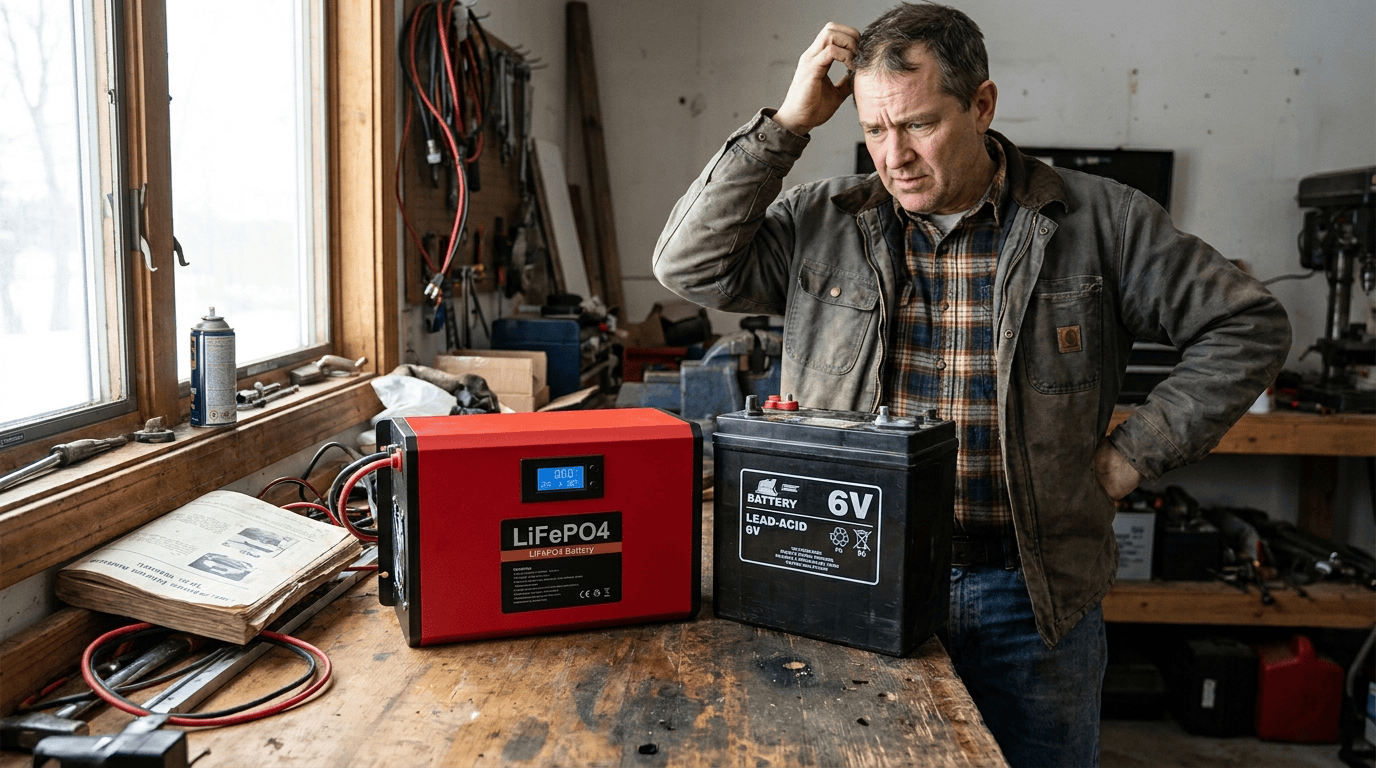
6-Volt RV Battery: Do They Still Make Sense?
Six-volt batteries have powered RV house banks for decades, and for good reason. A pair of 6V golf cart batteries wired in series gives you a true deep-cycle battery with thicker plates, better depth-of-discharge tolerance, and longer service life than most 12V AGM options. Here’s what you need to know before you buy — and when it makes more sense to skip them entirely and go straight to lithium.
What Are 6-Volt RV Batteries?
6-volt batteries used in RVs are almost always the GC2 (Golf Cart 2) format — the same batteries found in golf carts, floor scrubbers, and solar installations. They’re flooded lead-acid or AGM batteries built with thicker plates than standard automotive or marine batteries, which makes them better suited for the deep discharge and recharge cycles that RV living demands.
You always use them in pairs. Two 6V batteries wired in series produces 12V at the rated amp-hour capacity. Four batteries (two series pairs wired in parallel) gives you 12V at double the Ah. The larger physical size means more plate material, which translates to real capacity.
How to Wire 6V Batteries for an RV
Series wiring (two batteries → 12V): Connect the negative terminal of Battery 1 to the positive terminal of Battery 2. The open positive of Battery 1 and the open negative of Battery 2 become your 12V output. This doubles the voltage while keeping the Ah rating the same as a single battery.
Series-parallel (four batteries → 12V, 2x Ah): Build two series pairs as above, then connect the positives of both pairs together and the negatives together. The result is 12V at double the Ah. A common setup is four Trojan T-105 batteries (225Ah each) wired this way to produce a 12V/225Ah bank — enough for 2–3 days of moderate use.
Important: always use the same cable length for each battery connection in a parallel bank. Unequal resistance causes unequal charging, which kills batteries early.
Top 6-Volt RV Batteries
Trojan T-105 — The Gold Standard
The Trojan T-105 is the benchmark 6V golf cart battery. 225Ah capacity, flooded lead-acid construction, and a reputation for lasting 5–7 years with proper maintenance (monthly watering, equalization charges). It’s what most long-term RVers used before lithium became affordable. Still a solid choice if you already have a flooded battery setup and don’t want to overhaul your charging system.
Specs: 6V | 225Ah | Flooded lead-acid | ~62 lb each | Requires monthly watering
Check Trojan T-105 prices on Amazon →
Interstate Batteries 6V GC2 — Best for Availability
Interstate makes a solid GC2-format 6V battery widely available at Costco, Sam’s Club, and automotive retailers. Capacity typically runs 200–215Ah — slightly less than a Trojan T-105 but meaningful savings on upfront cost. Core exchange programs at many retailers reduce the total cost further. If you’re buying locally and want to avoid shipping lead batteries, Interstate is the practical choice.
Specs: 6V | 200–215Ah | Flooded lead-acid | ~60 lb each
Check Interstate 6V prices on Amazon →
Crown CR-220 — Best Long-Life Flooded
Crown batteries are a favorite among serious boondockers for their build quality and cycle life. The CR-220 is a 6V/220Ah flooded battery with thicker plates than most competitors — some RVers report 7–10 years of service life with proper equalization and watering. Harder to find locally than Interstate or Trojan, but worth ordering if you plan to keep your current system for years.
Specs: 6V | 220Ah | Flooded lead-acid | ~63 lb each
Check Crown CR-220 prices on Amazon →
6-Volt vs. 12-Volt Lithium: Which Should You Buy?
| Factor | 6V AGM/Flooded | 12V Lithium (LiFePO4) |
|---|---|---|
| Upfront cost (200Ah usable) | $200–$400 (4 batteries) | $270–$400 (1–2 batteries) |
| Weight (200Ah bank) | 240–260 lb | 47–60 lb |
| Usable capacity | 50% (100Ah from 200Ah bank) | 95–100% |
| Cycle life | 400–700 cycles | 4,000–15,000 cycles |
| Charge time | 8–12 hours | 1–3 hours |
| Maintenance | Monthly watering (flooded) | None |
| Lifespan | 3–7 years | 10–15 years |
The math has shifted. In 2020, lithium was 3–4x more expensive than 6V AGM. Today, a pair of Redodo 100Ah lithium batteries costs about the same as four quality 6V golf cart batteries — and delivers more usable energy, weighs 80% less, and lasts 5–10x longer. For most new builds or full replacements, 12V lithium is the smarter buy.
When 6-Volt Batteries Still Make Sense
Despite the lithium advantage, 6V batteries still make sense in a few situations: you already have a working 6V bank and just need to replace one or two batteries; you’re on a very tight budget and can find GC2 batteries locally for $80–$100 each; or you’re in a setup where weight isn’t a concern (fifth wheel or Class A with a dedicated battery bay that’s not near the axle). In these cases, a good set of Trojan T-105s will serve you well for years.
If you’re starting fresh, adding solar, or replacing a full worn-out bank, skip the 6V AGM step and go straight to a 12V lithium battery. You’ll save weight, gain capacity, and never have to water a battery again.
FAQ
Can I replace my 6V batteries with 12V lithium?
Yes. Remove the series-wired 6V pair and install a single 12V lithium in the space. You may need a hold-down bracket since lithium batteries are lighter and smaller. Update your converter to a lithium charging profile and you’re done. Most RVers do this as a direct replacement with no other wiring changes.
Do 6V batteries last longer than 12V batteries?
6V flooded batteries last longer than 12V flooded or AGM batteries of comparable quality — typically 5–7 years versus 3–5 years for 12V AGM. But 12V lithium batteries outlast both, often running 10–15 years with minimal degradation. If longevity is the goal, lithium wins clearly.
How many 6V batteries do I need?
Always use 6V batteries in multiples of two (since you wire them in series pairs). Two batteries is the minimum (giving you one 12V bank). Four batteries doubles your capacity. Most RVers using 6V flooded batteries run four — two series pairs wired in parallel — for a 225Ah bank at 12V.
Bottom line: 6V golf cart batteries are a proven, affordable option — but the economics now favor 12V lithium for most buyers. If you’re replacing an existing 6V bank on a tight budget, the Trojan T-105 remains the gold standard. Everyone else should consider making the jump to lithium instead.