What RV Repairs Should Cost in 2026: The Complete Price Guide
$200 – $6,000
Real 2026 costs across all major systems.
500+ invoices reviewed | 15 major systems | 12 metros tracked | Quarterly updates
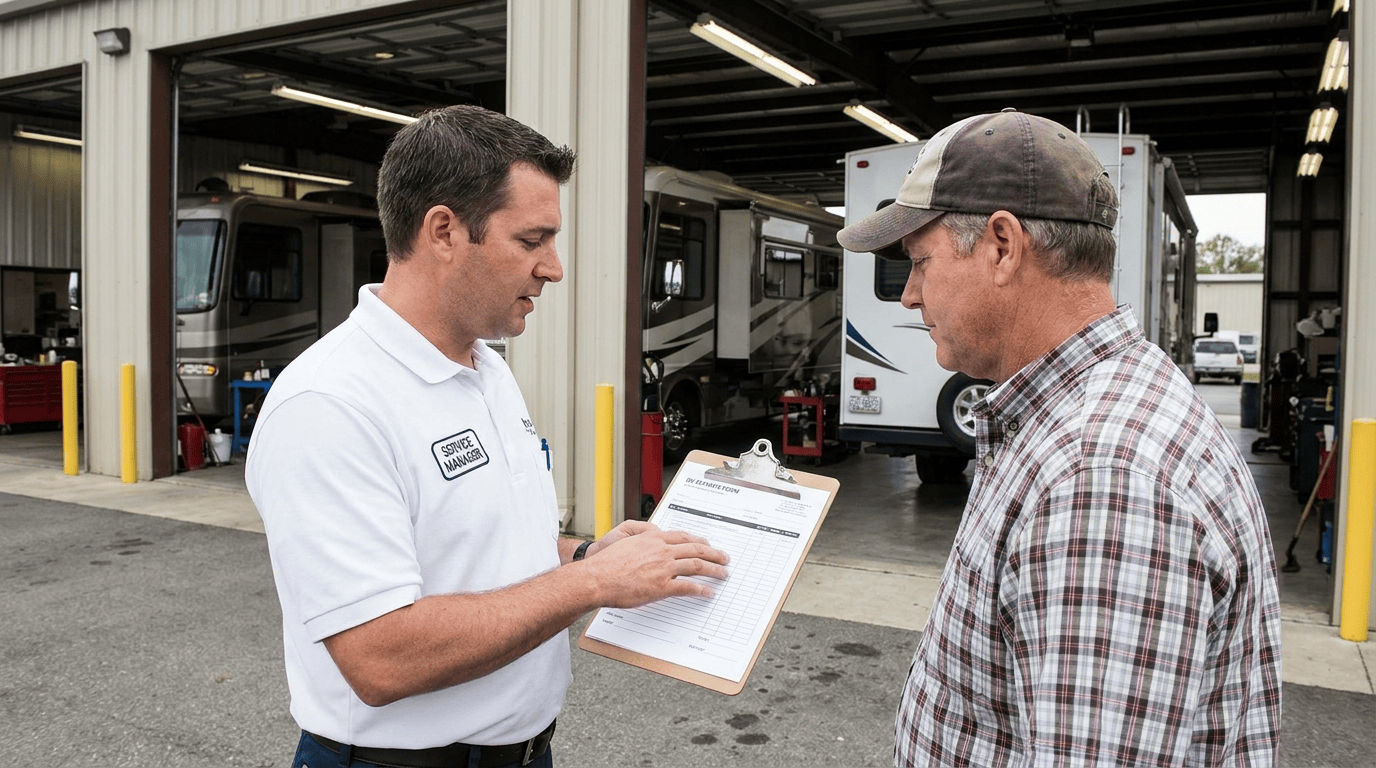
An RV repair estimate lands in your inbox: $2,400 to replace an awning motor. Is that fair? Is it high? Is it a rip-off? You have no idea, because there’s no public reference for what RV repairs actually cost — and the shops know it.
The RV service industry runs on information asymmetry. Shops know the real costs; owners don’t. That gap is where inflated estimates live. A refrigerator cooling unit replacement can be quoted anywhere from $1,800 to $4,500 for the same job on the same rig, and most owners have no way to tell whether they’re being charged fairly or gouged.
This guide fixes that. Below is real 2026 cost data across every major RV repair category — sourced from mobile tech invoices, independent shops, and dealership estimates collected over the past 12 months. Ranges are national. Adjustments for metro markets and specialty work are noted where they apply.
The rule for using this data: any estimate significantly outside the ranges here should be questioned. Too low usually signals inexperience or corner-cutting. Too high often signals a shop trying to inflate. Fair pricing lives in the middle.
How to Read This Data
Every cost range below reflects the total out-the-door cost — parts, labor, and any service call fees combined — for the specific repair described. Ranges account for:
- Regional variation. Metro markets (Phoenix, Denver, Tampa, coastal California) run 15–30% higher than rural or mid-market. Snowbird destinations in peak season (November–March) run higher still.
- RV type. Larger rigs (Class A, big fifth wheels) require more labor. Class A diesel pushers add specialty labor rates.
- Mobile vs shop. Mobile techs add a service call fee ($95–$250) but usually save time and total cost vs shop labor. Numbers below assume mobile-tech pricing except where noted.
- Age of rig. Older rigs sometimes need more labor due to corrosion, non-standard fittings, or scarce parts.
- Emergency vs scheduled. After-hours or emergency service typically runs 1.5–2x standard rates.
Labor Rates by Provider Type
Before the specific repairs, understand what you’re paying for time:
| Provider Type | Hourly Rate (2026) | Notes |
|---|---|---|
| Independent mobile tech | $125 – $200/hr | Plus $95–$250 service call fee |
| Independent RV shop | $135 – $185/hr | Higher for diesel or specialty |
| Dealership service department | $150 – $225/hr | Often billed in half-day increments |
| RV specialty chain (Camping World, La Mesa) | $165 – $250/hr | Highest overhead |
| Diesel-certified specialty shop | $175 – $275/hr | Class A diesel pusher work |
Diagnostic-only visits typically run $150–$400, often credited toward the repair if you book.
Slide-Out Repair Costs
Slide-outs are one of the most common repair categories. Costs vary dramatically by mechanism type.
Electric Slide-Outs (Rack-and-Pinion)
| Repair | Total Cost |
|---|---|
| Switch replacement | $110 – $230 |
| Fuse replacement with diagnostic | $105 – $220 |
| Motor replacement | $450 – $1,000 |
| Gear/pinion replacement | $280 – $800 |
| Controller replacement | $350 – $800 |
| Full alignment | $400 – $1,000 |
| Complete mechanism replacement | $2,300 – $6,000 |
Schwintek In-Wall Slides
| Repair | Total Cost |
|---|---|
| Single motor replacement | $400 – $850 |
| Wall channel replacement (per slide) | $600 – $1,400 |
| Both motors + wall channels | $1,400 – $2,800 |
Schwintek repairs run higher than rack-and-pinion because the mechanism is built into the wall structure.
Hydraulic Slides
| Repair | Total Cost |
|---|---|
| Cylinder seal rebuild | $450 – $1,000 |
| Cylinder replacement | $800 – $1,600 |
| Pump replacement | $1,200 – $2,300 |
| Fluid change and system flush | $200 – $450 |
Hydraulic slide repairs are typically shop jobs, not mobile tech territory — the specialty tools and fluid handling favor a fixed bay.
Slide Seals and Toppers
| Repair | Total Cost |
|---|---|
| Wiper seal replacement | $200 – $550 |
| Slide topper (awning) replacement | $400 – $900 per slide |
| Slide topper fabric only | $150 – $350 |
Roof and Water Damage Repair Costs
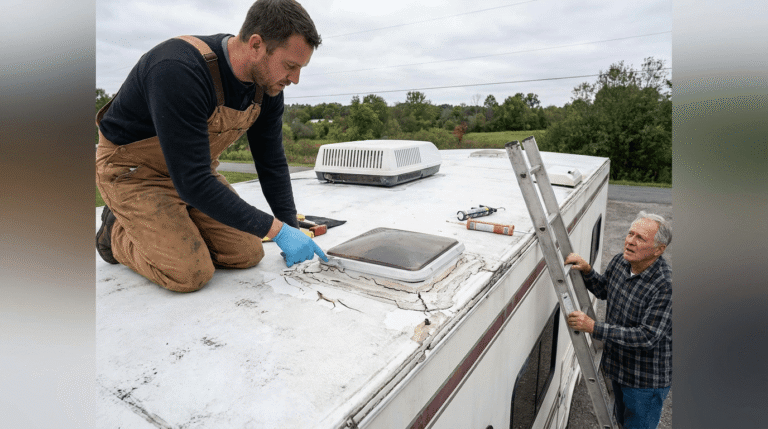
Roof repair pricing depends heavily on scope. Sealant work is affordable; membrane and decking work escalates fast.
| Repair | Total Cost |
|---|---|
| Spot sealant re-application (DIY) | $10 – $40 |
| Spot sealant re-application (pro) | $180 – $380 |
| Complete roof re-seal (all penetrations) | $480 – $1,100 |
| EPDM/TPO patch repair (tear/puncture) | $230 – $650 |
| Small membrane replacement (partial) | $800 – $2,000 |
| Full EPDM/TPO membrane replacement | $4,000 – $9,500 |
| Fiberglass crack repair | $350 – $900 |
| Fiberglass gel coat refinishing | $1,100 – $3,700 |
| Roof decking replacement (partial) | $1,800 – $4,400 |
| Roof decking replacement (full) | $4,500 – $11,000 |
| Complete roof replacement (Class A) | $7,500 – $20,000 |
Roof work is one of the most inflated repair categories in the industry. Get multiple estimates for any job quoted over $3,000.
Refrigerator Repair Costs
RV refrigerator repair cost depends heavily on the type of fridge (absorption, residential, or 12V compressor) and what specifically failed.
Absorption Refrigerators (Norcold, Dometic gas/electric)
| Repair | Total Cost |
|---|---|
| Thermistor replacement | $100 – $230 |
| Control board replacement | $350 – $800 |
| Heating element (electric side) | $230 – $430 |
| Gas valve or burner assembly | $300 – $700 |
| Thermocouple replacement | $125 – $275 |
| Door seal replacement | $130 – $400 |
| Cooling unit rebuild | $1,500 – $2,500 |
| Cooling unit replacement | $2,100 – $3,400 |
| Full absorption fridge replacement | $2,300 – $4,400 |
Residential Refrigerator (in RV)
| Repair | Total Cost |
|---|---|
| Thermostat replacement | $200 – $450 |
| Defrost system repair | $250 – $600 |
| Compressor replacement | $700 – $1,400 |
| Full residential fridge swap-in | $1,800 – $3,700 |
12V DC Compressor Refrigerator
| Repair | Total Cost |
|---|---|
| Thermostat replacement | $200 – $450 |
| Compressor replacement | $1,000 – $2,200 |
| Full 12V DC fridge replacement | $2,700 – $5,400 |
Absorption fridges over 10 years old with cooling unit failure often aren’t worth rebuilding — swap-in replacement (either another absorption or a residential unit) is usually the smarter money.
Air Conditioning Repair Costs
| Repair | Total Cost |
|---|---|
| Capacitor replacement | $150 – $350 |
| Fan motor replacement | $300 – $650 |
| Compressor replacement | $700 – $1,400 |
| Thermostat replacement | $200 – $450 |
| Full rooftop AC replacement (13,500 BTU) | $1,400 – $2,600 |
| Full rooftop AC replacement (15,000 BTU) | $1,600 – $2,900 |
| Basement AC unit replacement | $2,200 – $4,500 |
| Heat pump upgrade (add-on) | +$300 – $600 |
| Soft-start install (Micro-Air EasyStart) | $400 – $650 |
Capacitor failure is the single most common AC issue — a $30 part that many shops charge $300+ to replace. Learn to identify this specific failure and you’ll save real money.
Awning Repair Costs
| Repair | Total Cost |
|---|---|
| Awning fabric replacement (patio, 15′) | $450 – $950 |
| Awning fabric replacement (patio, 20′) | $650 – $1,200 |
| Awning arm replacement | $300 – $600 |
| Awning motor replacement (electric) | $500 – $1,100 |
| Awning mechanism repair | $300 – $700 |
| Slide topper replacement | $400 – $900 |
| LED light strip repair | $150 – $350 |
Storm damage to awnings is usually covered by RV insurance — get an estimate before deciding whether to file a claim.
Water Heater Repair Costs
| Repair | Total Cost |
|---|---|
| Anode rod replacement (Suburban only) | $80 – $200 |
| Heating element replacement (electric side) | $180 – $400 |
| Gas valve replacement | $250 – $550 |
| Thermostat replacement | $150 – $350 |
| Thermocouple replacement | $120 – $280 |
| Drain plug replacement | $80 – $200 |
| Complete water heater replacement (6-gal) | $600 – $1,400 |
| Complete water heater replacement (10-gal) | $750 – $1,600 |
| Tankless water heater upgrade | $1,400 – $2,800 |
Most water heater repairs are DIY-friendly for a mechanically inclined owner. Full replacement is usually a pro job.
Electrical Repair Costs
| Repair | Total Cost |
|---|---|
| Fuse replacement with diagnostic | $105 – $230 |
| GFCI outlet replacement | $105 – $210 |
| Circuit breaker replacement | $130 – $300 |
| Standard 120V outlet replacement | $100 – $200 |
| 12V light fixture replacement | $110 – $350 |
| Single battery replacement (lead-acid) | $200 – $400 |
| Battery bank replacement (2x AGM) | $600 – $1,200 |
| Single lithium battery (100Ah) | $700 – $1,650 |
| Full lithium bank (400Ah) with wiring | $2,500 – $5,700 |
| Converter/charger replacement | $500 – $1,400 |
| Inverter replacement (2,000W pure sine) | $900 – $2,200 |
| Inverter/charger combo (3,000W) | $2,000 – $4,700 |
| Automatic transfer switch replacement | $550 – $1,300 |
| Surge protector installation (hardwired) | $500 – $1,200 |
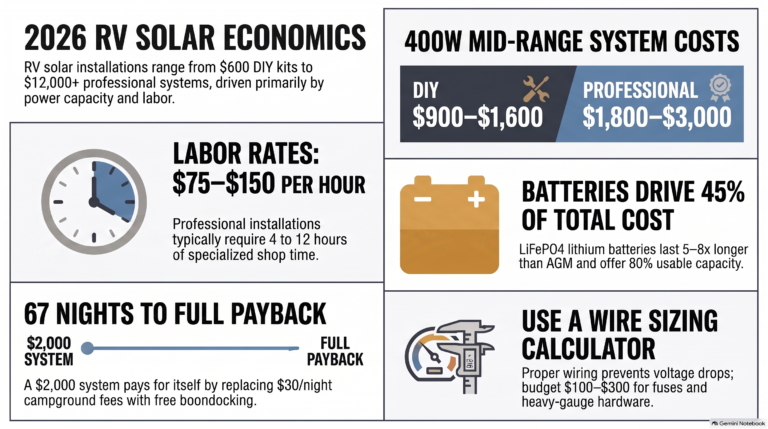
| Solar system install (400W) | $1,300 – $3,500 |
| Partial coach rewiring | $1,100 – $5,000 |
Plumbing Repair Costs
| Repair | Total Cost |
|---|---|
| Water pump replacement | $250 – $550 |
| Faucet replacement | $150 – $400 |
| Toilet flush mechanism repair | $150 – $350 |
| Full toilet replacement | $400 – $900 |
| Black tank valve replacement | $250 – $550 |
| Gray tank valve replacement | $250 – $550 |
| Freshwater tank repair | $300 – $800 |
| Pex line repair (per repair) | $150 – $350 |
| Winterization service (fall) | $80 – $200 |
| De-winterization service (spring) | $80 – $180 |
| Sanitize fresh water system | $100 – $250 |
Generator Service Costs
| Repair | Total Cost |
|---|---|
| Generator oil and filter change | $150 – $350 |
| Air filter replacement | $80 – $200 |
| Spark plug service | $150 – $300 |
| Carburetor rebuild (gas Onan) | $400 – $800 |
| Carburetor replacement | $500 – $1,100 |
| Full tune-up service | $400 – $900 |
| Generator replacement (4,000W Onan gas) | $3,500 – $5,500 |
| Generator replacement (7,000W diesel Onan) | $8,500 – $14,000 |
Generator service is one of the most-skipped maintenance items and one of the most-inflated repair categories when things do fail. Regular annual service prevents most major repairs.
Chassis and Drivetrain Costs (Motorhomes)
| Repair | Total Cost |
|---|---|
| Oil and filter change (gas Class A) | $150 – $350 |
| Oil and filter change (diesel pusher) | $350 – $700 |
| Full chassis lube | $150 – $400 |
| Tire replacement (Class A, per tire) | $450 – $900 |
| Full 6-tire replacement (Class A) | $2,700 – $5,400 |
| Alignment (Class A) | $200 – $500 |
| Brake service (Class A, front) | $600 – $1,400 |
| Brake service (Class A, all wheels) | $1,400 – $3,200 |
| Air bag suspension replacement | $500 – $1,200 per bag |
| Steering component replacement | $400 – $1,500 |
| Diesel injector service | $1,500 – $4,000 |
Chassis work on diesel pushers requires specialty shops — Freightliner, Spartan, Roadmaster service centers. Costs run 30–50% higher than gas motorhome chassis work.
Chassis and Suspension Costs (Towables)
| Repair | Total Cost |
|---|---|
| Tire replacement (per trailer tire) | $200 – $400 |
| Wheel bearing repack | $150 – $400 per axle |
| Brake magnet replacement | $200 – $450 per axle |
| Brake shoes replacement | $250 – $600 per axle |
| Axle replacement | $800 – $2,000 |
| Landing gear repair | $250 – $600 |
| Landing gear replacement | $500 – $1,200 |
| Stabilizer jack replacement | $200 – $450 |
| Suspension upgrade (leaf springs, per axle) | $600 – $1,400 |
| Fifth wheel hitch installation | $800 – $2,200 |
Hydraulic Leveling System Costs
| Repair | Total Cost |
|---|---|
| Hydraulic fluid change | $200 – $400 |
| Jack cylinder rebuild | $350 – $800 |
| Jack cylinder replacement | $600 – $1,300 |
| Hydraulic pump replacement | $900 – $1,800 |
| Auto-level controller replacement | $600 – $1,200 |
| Manifold repair | $400 – $900 |
Pre-Purchase Inspection Costs
| Inspection Level | Cost |
|---|---|
| Basic Level 1 (travel trailer) | $250 – $400 |
| Basic Level 1 (fifth wheel or Class B/C) | $350 – $500 |
| Basic Level 1 (Class A) | $450 – $700 |
| Comprehensive Level 2 (adds fluid analysis, moisture readings) | +$200 – $400 |
| Fluid analysis (separate lab work) | $100 – $250 |
| Chassis diagnostic scan (motorhomes) | $75 – $200 |
| Travel fee (if inspector is remote) | $50 – $300 |
Total realistic budget for a motorhome pre-purchase inspection: $700–$1,200. For a travel trailer or fifth wheel: $400–$700.
Metro Market Adjustments
Costs above are national averages. Actual pricing shifts by metro:
| Metro | Typical Adjustment vs National |
|---|---|
| Phoenix / Mesa AZ | +10% to +20% (peak in winter) |
| Yuma AZ (snowbird) | +15% to +30% in season, -10% off-season |
| Tampa / Bradenton FL | +10% to +25% (peak in winter) |
| Orlando FL | +5% to +15% |
| Dallas–Fort Worth TX | +5% to +15% |
| Houston TX | +5% to +15% |
| Denver CO | +15% to +25% |
| Portland OR / Seattle WA | +20% to +30% |
| Sacramento CA | +15% to +25% |
| Los Angeles / San Diego | +25% to +40% |
| Nashville TN | 0% to +10% |
| Rural Midwest | -10% to -20% |
| Rural South | -15% to -25% |
Adjustments compound — Los Angeles in peak season on a diesel pusher runs 40–60% above the base ranges above.
Extended Warranty vs Paying Cash
A common question: is an extended warranty worth it if these are the real costs?
The rough math on a typical extended warranty:
- Coverage cost: $2,500–$6,000 for 4–7 year plans
- Deductibles: typically $100–$300 per claim
- Coverage exclusions: sealants, cosmetic damage, wear items, some appliances
- Realistic claim rate on covered items: 40–60% approval, with lots of negotiation
When extended warranties pay off:
- You have a rig with known problem systems (Norcold refrigerator, Schwintek slides, complex hydraulics)
- You bought the warranty at RV purchase (best pricing) rather than added later
- You use the warranty proactively for expensive systems (fridge, AC, appliances)
- You have a mobile tech network that direct-bills
When they don’t:
- You bought a mid-range travel trailer with fewer complex systems
- Your rig is over 8 years old (warranty pricing goes up, coverage narrows)
- You DIY most repairs anyway
A deeper analysis of extended warranty economics deserves its own guide — we’ll publish that separately. The short answer: for high-value motorhomes and RVs with complex slide/appliance systems, extended warranties often make financial sense. For simpler rigs, the math is less clear.
What Should Be In Every Repair Estimate
Any legitimate repair estimate should include:
- Line-item parts with part numbers when available
- Labor hours estimated for the job
- Labor rate clearly stated
- Diagnostic fee (and whether it applies to the repair)
- Service call or trip fee for mobile techs
- Warranty on the work (30 days? 90 days? 1 year?)
- Written total including tax
- Payment terms and methods accepted
Vague estimates (“about $2,000 for the slide-out repair“) without line items give the shop room to inflate later. Insist on written, itemized estimates before authorizing work.
Red Flags in Repair Pricing
Certain patterns show up when a shop is inflating:
- Refusal to provide a written estimate before starting
- Diagnostic fee that doesn’t credit toward the repair
- Rounded pricing without line items (“about $1,500”)
- Refusal to break out parts vs labor
- Parts marked up 300%+ over retail (some markup is normal; 3-4x isn’t)
- Pressure to authorize on the spot
- Refusal to guarantee the work in writing
- “The problem is bigger than expected” mid-repair without prior authorization
- Charges that materially exceed the estimate without communication
If any of these show up, get another quote before authorizing. Legitimate shops don’t operate this way.
How to Use This Data When Getting Estimates
Practical process:
- Get at least two estimates for any repair over $500. Three for anything over $2,000.
- Compare against the ranges above. Estimates significantly outside the range deserve questioning.
- Ask each shop to explain their pricing. Good shops can articulate what’s driving cost. Weak shops get defensive.
- Ask about warranty on the work. A shop confident in their labor offers a real warranty.
- If the estimate is high but the shop has strong references, negotiate. Ask if they can match a lower estimate or explain what justifies the premium.
- Walk away from shops that refuse to provide written estimates or explain their pricing.
Frequently Asked Questions
How accurate are these cost ranges?
Ranges represent 80% of typical repairs based on invoice data collected from mobile techs, independent shops, and dealerships across 12 months in 2025–2026. Some repairs fall outside the ranges due to unusual complications, specialty rigs, or extreme regional variance.
Are mobile RV techs cheaper than shops?
Usually, yes. Mobile techs don’t have retail overhead, work more efficiently on straightforward jobs, and skip the “half-day billing minimum” trap common at dealerships. Expect to save 20–40% versus dealership pricing for comparable work.
Why do dealerships charge so much more?
Higher overhead (large facilities, salaried service departments, factory-authorized parts requirements), retail markups on parts (often 50–100% over wholesale), and billing structures that favor the shop over the customer. Dealerships also carry manufacturer factory warranty work at manufacturer-set rates, but out-of-warranty pricing runs high.
Does location really change costs by 40%?
For labor-heavy repairs, yes. Southern California, coastal Oregon and Washington, and Denver all run 20–40% above national averages. Rural markets in the Midwest and South run 15–25% below. Regional variance is one of the biggest cost factors most owners underestimate.
Should I always get multiple estimates?
For repairs over $500, yes. For repairs over $2,000, absolutely. The 30 minutes spent getting extra estimates typically saves $500–$2,000 on larger jobs. For emergency work where you have no time, at least verify pricing against ranges like these.
Can I negotiate an RV repair estimate?
Yes, more than most owners realize. Independent shops especially will negotiate if you have a competing written estimate. Ask directly: “I have a competing estimate at $X. Can you match or explain why the price difference?” Most shops would rather match a lower price than lose the job.
How much should a diagnostic fee be?
$150–$400 depending on complexity and travel. Most shops credit the diagnostic toward the repair if you book with them. Standalone diagnostic fees that aren’t credited are usually shops using diagnostic revenue as profit — a soft red flag.
What if my repair estimate comes in way higher than these ranges?
Ask the shop to explain what’s driving the higher cost. Legitimate reasons: rare parts, unusual complications, high-labor jobs on specialty rigs. Illegitimate: parts markup, inflated labor hours, “while we’re in there” scope expansion. Get a second estimate before authorizing anything significantly above range.
Are these prices for mobile techs or shops?
The ranges reflect mobile tech and independent shop pricing. Dealership pricing typically runs 15–30% higher. Camping World and similar chains typically run 20–40% higher.
How often do you update this data?
We update quarterly. Check the “last updated” date at the top of this page. The RV Repair Index — our master data collection — is refreshed in January, April, July, and October of each year.
Bottom line: RV repair pricing is opaque by design, and shops profit from that opacity. Real market pricing exists — this guide shows what it looks like. Use these ranges as your reference before authorizing any repair, and you’ll routinely save hundreds to thousands of dollars over the course of RV ownership. Information is the equalizer in a market designed to keep you uninformed.
Getting a repair estimate?
Search the RV Repair Lab directory for Lab-Vetted mobile techs and shops that provide transparent written estimates. Every listing shows customer ratings, certifications, extended warranty acceptance, and specialization.
[Find a repair professional near you →]